Understand zero-rated supplies and exempt supplies in Singapore, including GST treatment, input tax recovery, registration, reporting and common errors.
TLDR:
- Zero-rated supplies are taxable supplies charged at 0% GST.
- Exempt supplies fall outside taxable supplies, and GST is not charged.
- Input tax linked to zero-rated supplies is generally claimable, subject to the normal conditions.
- Input tax linked to exempt supplies is generally not claimable unless an exception applies.
- Zero-rated supplies count towards taxable turnover for GST registration, while exempt supplies generally do not.
- Incorrect classification can affect invoices, GST returns, registration and input tax claims.
Zero-rated supplies and exempt supplies receive different treatment under Singapore’s GST system: Section 21 of the Goods and Services Tax Act 1993 treats qualifying exports and international services as taxable supplies charged at 0%, while Section 22 provides the statutory basis for exempt supplies and imports.[1] A GST-registered business generally claims input tax incurred to make zero-rated supplies but generally cannot claim input tax incurred to make exempt supplies. Business owners and finance teams must classify each transaction correctly before preparing invoices, assessing GST registration liability or filing a GST return.
What are zero-rated supplies and exempt supplies?
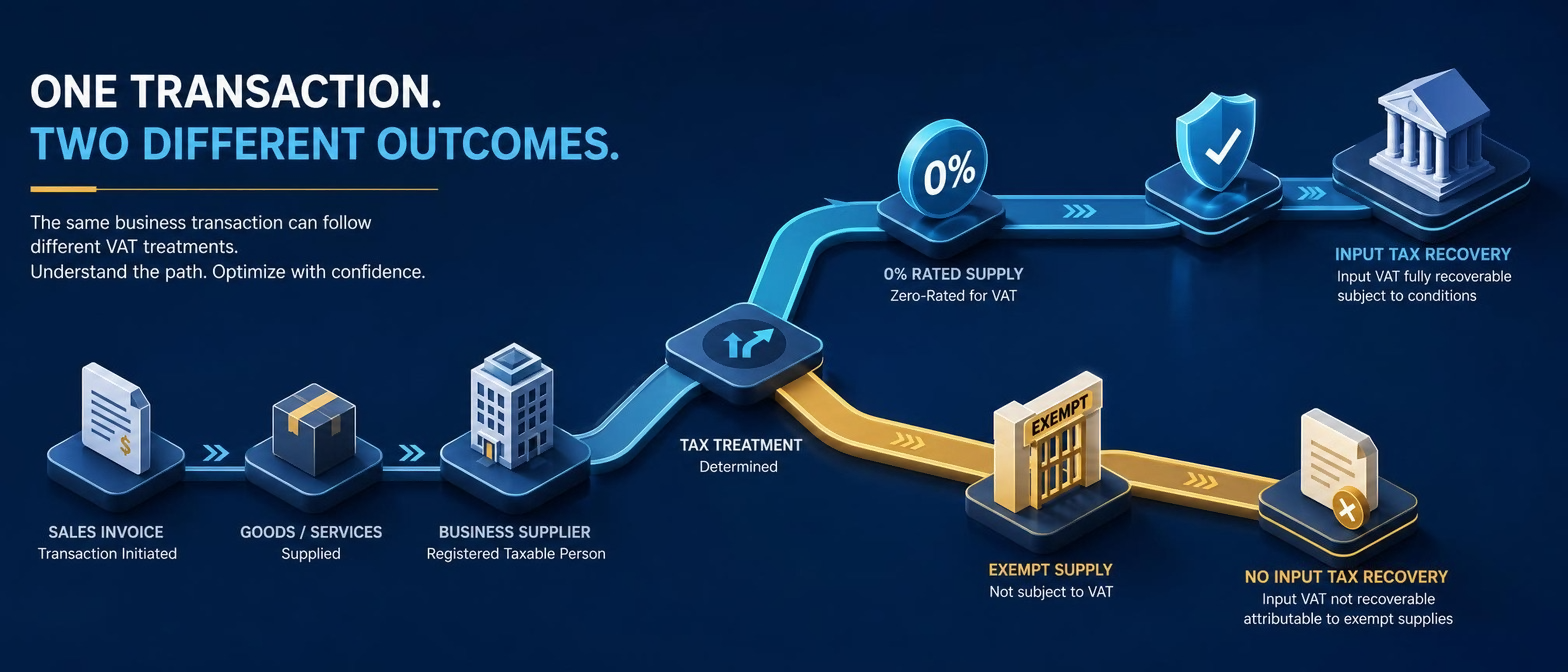
Zero-rated supplies are taxable supplies charged at 0% GST, while exempt supplies are non-taxable supplies on which GST is not charged.
Section 21 of the Goods and Services Tax Act 1993 states that a supply of goods is zero-rated only if the goods are exported and a supply of services is zero-rated only if the services are international services, subject to the detailed provisions in Sections 21, 21A, 21B and 21C.[1] A zero-rated transaction remains a taxable supply even though the applicable GST rate is nil.
Section 22 of the Goods and Services Tax Act 1993 provides that supplies and imports described in the Fourth Schedule are exempt from GST.[1] An exempt transaction does not become a taxable supply merely because no GST appears on the invoice.
The distinction matters beyond the customer-facing GST amount. Zero-rated supplies contribute to taxable turnover and generally support input tax recovery, while exempt supplies generally restrict input tax recovery and do not ordinarily contribute to taxable turnover for domestic GST registration purposes.[3][5]
For the wider registration framework, see E&H Corporate Services’ pillar guide, GST in Singapore: Who Must Register and When?
How do zero-rated supplies compare with exempt supplies?
The main difference is that zero-rated supplies remain taxable, while exempt supplies do not.
| GST issue | Zero-rated supplies | Exempt supplies |
|---|---|---|
| Legal treatment | Zero-rated supplies are taxable supplies under Section 21 of the Goods and Services Tax Act 1993.[1] | Exempt supplies fall within Section 22 and the Fourth Schedule to the Goods and Services Tax Act 1993.[1] |
| GST charged to customer | GST is charged at 0%.[2] | GST is not charged.[3] |
| Input tax recovery | Input tax incurred to make zero-rated supplies is generally claimable when the normal input tax conditions are satisfied.[2] | Input tax incurred to make exempt supplies is generally not claimable unless the De Minimis Rule or another applicable recovery rule permits the claim.[4] |
| GST registration turnover | Zero-rated supplies form part of taxable turnover.[5] | Exempt supplies generally do not form part of taxable turnover under the domestic registration test.[5] |
| GST return | The value is reported as zero-rated supplies. | The value is reported as exempt supplies. |
| Typical examples | Exported goods and qualifying international services.[1][2] | Certain financial services, digital payment tokens, the sale or lease of residential properties, and the import or local supply of investment precious metals.[3] |
| Supporting evidence | The business must retain evidence that the statutory zero-rating conditions are satisfied.[2] | The business must retain records supporting the applicable exemption and any input tax allocation.[3][4] |
A 0% GST rate does not make a zero-rated supply the same as an exempt supply. The transaction’s legal classification determines registration, reporting and input tax consequences.
Which transactions qualify as zero-rated supplies?
Qualifying exports of goods and international services are the principal categories of zero-rated supplies in Singapore.
Section 21 states that goods qualify for zero-rating only if the goods are exported, subject to the statutory conditions and related zero-rating provisions.[1] A sale to an overseas customer does not automatically qualify when the goods remain in Singapore.
IRAS requires a supplier to establish that exported goods have been or will be exported and to maintain the prescribed supporting documents.[2] Relevant records can include export permits, transport documents, commercial invoices, delivery evidence and payment records, depending on the export arrangement.
Section 21(3) lists the services treated as international services.[1] An overseas billing address alone does not establish zero-rating because the service must satisfy the wording of a specific international-services provision.
Common commercial examples can include qualifying international transport, services directly connected with overseas land or goods situated outside Singapore, and specified services supplied under the statutory overseas-person conditions. Each service should be tested against the applicable Section 21(3) provision rather than classified from the customer’s location alone.
Which transactions are exempt supplies?
Exempt supplies include specified financial services, digital payment tokens, residential property transactions and investment precious metals.
IRAS identifies the following principal categories of exempt supplies: the provision of financial services; the supply of digital payment tokens; the sale and lease of residential properties; and the import and local supply of investment precious metals.[3] The detailed scope of each exemption depends on the Fourth Schedule to the Goods and Services Tax Act 1993 and the facts of the transaction.[1]
Financial-service exemptions can include the provision of loans, the exchange of currency and the issue or sale of shares or bonds.[3] Fees for separate administrative, advisory or management services require their own analysis because a connection with a financial transaction does not automatically make every fee exempt.
Residential property treatment requires the business to distinguish the residential component from taxable components. Commercial property transactions remain subject to the ordinary GST rules, while the sale or lease of residential property falls within the relevant exemption.[3]
Investment precious metals must meet the statutory criteria for the exemption. Ordinary jewellery, collectible coins and precious-metal products do not become exempt solely because they contain gold, silver or platinum.
How do zero-rated and exempt supplies affect input tax claims?
Input tax attributable to zero-rated supplies is generally claimable, while input tax attributable to exempt supplies is generally not claimable.
Zero-rated supplies remain taxable supplies, so qualifying business expenses used to make those supplies can support input tax claims under the normal recovery rules.[1][2] A business must still hold valid supporting documents, use the purchase for its business and satisfy the other input tax conditions.
Exempt supplies generally block recovery of directly attributable input tax.[3][4] A property owner that incurs brokerage fees solely to arrange an exempt residential lease, for example, generally cannot claim the associated input tax unless a specific recovery rule applies.
Shared expenses require attribution and apportionment when a GST-registered business makes both taxable and exempt supplies. Residual input tax can arise from expenses such as audit fees, office rent, software and general administration that support the business as a whole rather than one identifiable supply.[4]
Partial-exemption calculations can become material for investment holding companies, property groups, lenders, payment businesses and trading companies that earn interest or realise foreign-exchange gains alongside taxable operating revenue. Finance teams should map each expense to taxable supplies, exempt supplies or residual use before completing the GST return.
What is the De Minimis Rule for exempt supplies?
The De Minimis Rule can allow a GST-registered business to claim input tax linked to exempt supplies when the value of those supplies remains within both prescribed limits.
IRAS states that the value of exempt supplies must be less than or equal to an average of S$40,000 per month and 5% of the total value of all taxable and exempt supplies made in the relevant period.[4] Both conditions must be satisfied.
A business that satisfies the De Minimis Rule may provisionally claim input tax incurred in making exempt supplies, subject to the remaining input tax rules.[4] A prohibited expense does not become claimable merely because the business passes the De Minimis Rule.
A business must also perform the required longer-period adjustment because quarterly or monthly results can differ from the position across the longer period.[4] The adjustment may increase or reduce the final recoverable amount.
A business that fails the De Minimis Rule must generally exclude input tax directly attributable to exempt supplies and apportion residual input tax.[4] Additional rules can apply to specified Regulation 33 exempt supplies and businesses covered by Regulation 34.
How is residual input tax apportioned for mixed supplies?
Residual input tax is apportioned after the business directly attributes expenses to taxable supplies or exempt supplies.
- List the supplies made during the accounting period. Separate standard-rated supplies, zero-rated supplies, exempt supplies and out-of-scope transactions using the statutory classifications.
- Directly attribute each purchase where possible. Allocate expenses used solely for standard-rated or zero-rated supplies to taxable activity and allocate expenses used solely for exempt supplies to exempt activity.
- Identify residual expenses. Treat shared overheads that cannot be directly attributed as residual input tax.[4]
- Apply the De Minimis Rule. Compare exempt supplies with the average monthly limit and the percentage limit published by IRAS.[4]
- Apply the prescribed apportionment method when required. Calculate the recoverable portion of residual input tax using the applicable formula and exclude values that the rules require the business to disregard.[4]
- Complete the longer-period adjustment. Reconcile provisional claims across the longer period and account for the adjustment in the relevant GST return.[4]
- Retain the calculation and evidence. Keep the supply listings, tax invoices, allocation rationale and partial-exemption workings with the GST records.
A consistent allocation policy helps a business demonstrate why each expense was treated as taxable, exempt or residual. A year-end calculation prepared without transaction-level records can produce unsupported claims.
How do zero-rated and exempt supplies affect GST registration?
Zero-rated supplies count towards taxable turnover for the domestic GST registration test, while exempt supplies generally do not.
IRAS states that a business must apply for GST registration when it can reasonably expect its taxable turnover to exceed S$1 million in the next 12 months, subject to the applicable registration rules and deadlines.[5] Taxable turnover includes standard-rated and zero-rated supplies.
A business can cross the GST registration threshold even when most or all of its sales are charged at 0%. Exporters and international-service providers should therefore monitor taxable turnover instead of assuming that a nil customer-facing GST amount removes the registration obligation.
A business that is required to register but makes wholly or mainly zero-rated supplies may apply to the Comptroller for exemption from GST registration.[5] Approval is not automatic, and the business should compare the compliance cost of registration with the input tax that registration may allow it to recover.
Exempt supplies generally remain outside domestic taxable turnover, but businesses making exempt supplies may still face GST obligations under rules such as reverse charge. A complete registration review should consider purchases of imported services and low-value goods as well as sales.
How should zero-rated and exempt supplies be invoiced and reported?
Zero-rated supplies and exempt supplies require different invoice descriptions, GST return classifications and supporting records.
| Compliance step | Zero-rated supply | Exempt supply |
|---|---|---|
| Customer document | A tax invoice or commercial invoice should show that GST is charged at 0% when the document is issued as a tax invoice.[2] | The invoice should not charge GST and should describe the underlying exempt transaction accurately. |
| GST return category | The value should be included in the field for zero-rated supplies. | The value should be included in the field for exempt supplies. |
| Output tax | The output tax amount is nil because the applicable rate is 0%.[1] | No output tax is charged because the supply is exempt.[3] |
| Input tax | Related input tax is generally claimable subject to the normal conditions.[2] | Related input tax is generally not claimable unless the De Minimis Rule or another recovery provision applies.[4] |
| Evidence | The supplier should keep documents proving that the export or international service satisfies the statutory requirements.[2] | The supplier should keep documents proving that the transaction falls within an exempt category and supporting any partial-exemption calculation.[3][4] |
Accounting systems should use separate tax codes for zero-rated and exempt supplies. A single “no GST” code can conceal classification errors and produce incorrect GST return totals.
What mistakes do businesses make with zero-rated and exempt supplies?
Businesses commonly confuse zero-rated supplies with exempt supplies because neither category produces GST payable by the customer.
An overseas customer does not make every service zero-rated. A service qualifies only when the transaction satisfies a specific international-services provision in Section 21(3).[1]
An export invoice does not prove that goods left Singapore. IRAS requires the supplier to maintain the supporting evidence applicable to its export arrangement.[2]
An exempt sale does not automatically permit recovery of the related input tax. Input tax attributable to exempt supplies is generally not claimable unless the De Minimis Rule or another applicable rule permits recovery.[4]
Interest income can affect partial-exemption calculations even when lending is not the company’s main business. Finance teams should review bank interest, shareholder loans, intercompany financing, realised foreign-exchange gains and other financial transactions before filing.
Out-of-scope supplies should not be reported as exempt supplies. An out-of-scope transaction falls outside the Singapore GST charging framework, while an exempt supply falls within a statutory exemption.
A nil output-tax result does not make classification harmless. An incorrect code can distort taxable turnover, input tax recovery, GST registration analysis and return disclosures.
How does classification work in a mixed-supply business?
A mixed-supply business must classify revenue transaction by transaction and allocate input tax according to use.
An anonymised composite example involves a Singapore software company that sells subscriptions locally, supplies qualifying international services to overseas clients and earns interest from loans to a related local company. The company classifies local subscriptions as standard-rated supplies, qualifying overseas services as zero-rated supplies and local loan interest as exempt supplies.
The company includes local and zero-rated revenue in taxable turnover for its GST registration analysis.[5] The company excludes the exempt loan interest from domestic taxable turnover but includes the exempt value in its partial-exemption review.[4][5]
The company claims input tax on cloud infrastructure used for taxable subscriptions when the normal conditions are satisfied. The company treats legal fees incurred solely to draft the local loan as attributable to an exempt supply and tests the resulting restriction under the partial-exemption rules.[4]
The company classifies general accounting fees as residual because those services support taxable and exempt activities. The company then applies the De Minimis Rule and, where necessary, the prescribed apportionment and longer-period adjustment.[4]
The example shows why one company can make standard-rated, zero-rated and exempt supplies during the same accounting period. The example also shows why the customer’s GST rate and the company’s input tax entitlement require separate analyses.
What records should a business keep for zero-rated and exempt supplies?
A business should keep records that prove both the legal classification of each supply and the resulting input tax treatment.
Zero-rated export records can include contracts, purchase orders, invoices, export permits, bills of lading, airway bills, freight records, delivery evidence and payment records. The precise evidence depends on how the goods were exported.[2]
International-service records should identify the contractual customer, the customer’s business status and location, the direct beneficiary, the place connected with the service and the applicable Section 21(3) provision. A foreign address on an invoice provides only one part of the analysis.[1]
Exempt-supply records should identify the relevant statutory category and preserve the underlying agreements, property documents, financial statements or transaction records. Partial-exemption records should also show direct attribution, residual input tax, the De Minimis Rule calculation and the longer-period adjustment.[3][4]
A documented GST coding policy can improve consistency across sales, procurement and finance teams. The policy should explain which tax codes apply, what evidence must be obtained and who approves unusual transactions.
How can E&H Corporate Services help with GST classification?
E&H Corporate Services can help Singapore businesses classify supplies, review GST registration exposure and maintain defensible accounting records.
GST compliance support: E&H Corporate Services can review zero-rated and exempt transactions, map accounting tax codes, assess input tax recovery, prepare partial-exemption workings and support GST registration or return preparation. Engage E&H Corporate Services before filing when an overseas sale, property transaction, financial service or mixed-use expense has uncertain GST treatment.
Professional review is particularly useful when contracts involve multiple supplies, overseas recipients, financial income or shared expenses. The final tax treatment depends on the transaction documents and the applicable law.
Frequently Asked Questions
Are zero-rated supplies taxable supplies?
Zero-rated supplies are taxable supplies charged at 0% GST under Section 21 of the Goods and Services Tax Act 1993.[1]
Can a business claim input tax on zero-rated supplies?
A business can generally claim input tax incurred to make zero-rated supplies when the normal input tax conditions are satisfied.[2]
Can a business claim input tax on exempt supplies?
A business generally cannot claim input tax attributable to exempt supplies unless the De Minimis Rule or another applicable recovery provision allows the claim.[4]
Do zero-rated supplies count towards the GST registration threshold?
Zero-rated supplies count towards taxable turnover for the domestic GST registration test.[5]
Do exempt supplies count towards the GST registration threshold?
Exempt supplies generally do not count towards domestic taxable turnover, although reverse-charge and other registration rules may still affect the business.[5]
Is every sale to an overseas customer zero-rated?
An overseas sale is zero-rated only when the goods are exported or the services satisfy a specific international-services provision and all applicable conditions.[1][2]
What is the De Minimis Rule for exempt supplies?
The De Minimis Rule requires exempt supplies to be less than or equal to an average of S$40,000 per month and 5% of the total value of taxable and exempt supplies in the relevant period.[4]
Are out-of-scope supplies the same as exempt supplies?
Out-of-scope supplies are different from exempt supplies because out-of-scope transactions fall outside the Singapore GST charging framework, while exempt supplies receive exemption under the GST legislation.
Related reading
- GST in Singapore: Rates, Registration, Exemptions and Filing
- What is the difference between standard-rated, zero-rated, and exempt supplies?
- Does taxable turnover include zero-rated sales?
- Are exports exempt from GST?
- What is Taxable Supply?
Sources & References
- Goods and Services Tax Act 1993 — Singapore Statutes Online, Attorney-General’s Chambers
- Zero-rated Supplies — Inland Revenue Authority of Singapore
- Exempt Supplies — Inland Revenue Authority of Singapore
- Partial Exemption and Input Tax Recovery — Inland Revenue Authority of Singapore
- GST Registration — Inland Revenue Authority of Singapore