
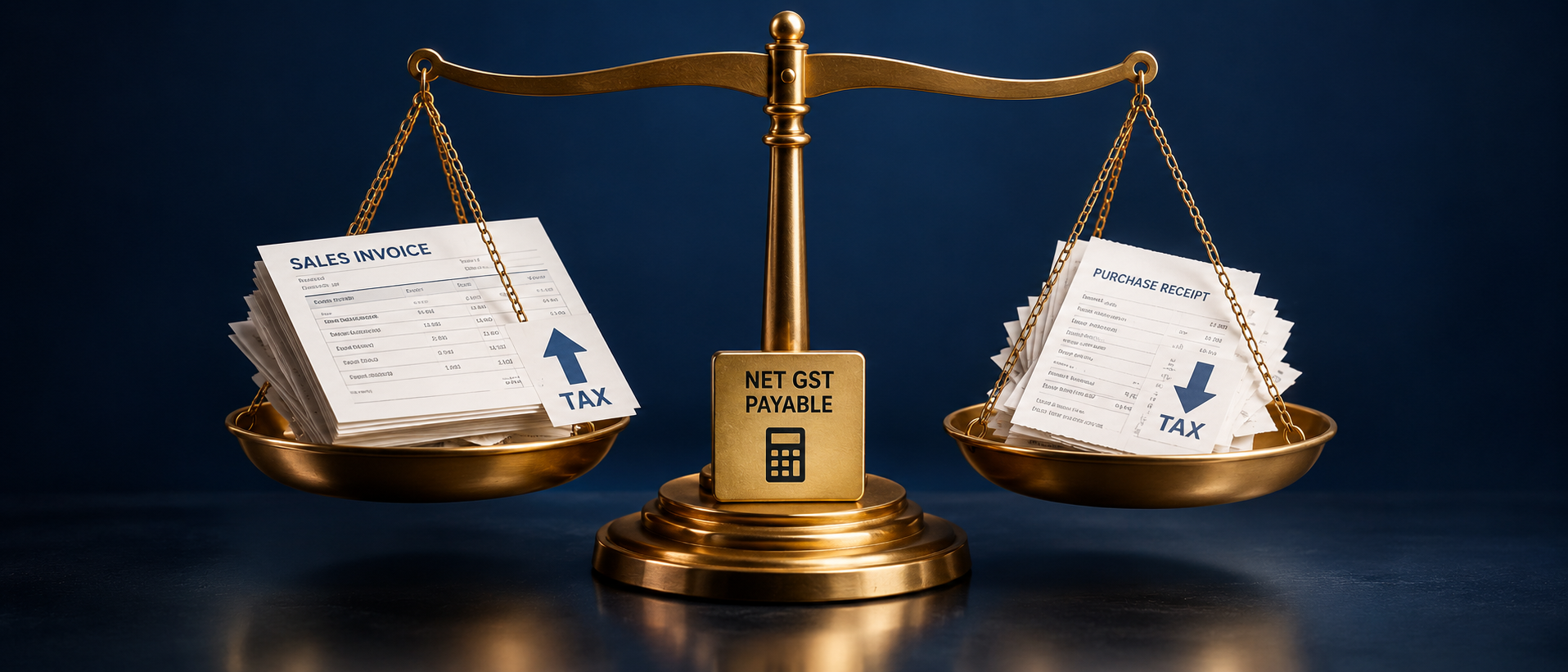
Understand GST input tax and output tax in Singapore, calculate net GST payable, identify claimable expenses and avoid common filing errors with IRAS.
TLDR:
- Output tax is the GST a GST-registered business charges on taxable sales.
- Input tax is the GST a GST-registered business incurs on eligible business purchases and imports.
- Net GST payable generally equals output tax minus claimable input tax.
- Singapore's prevailing GST rate is 9%.[1]
- Input tax is claimable only when every applicable IRAS condition is satisfied.[3]
- GST returns and any payment are due one month after the end of the accounting period.[5]
GST input tax and output tax are the two sides of Singapore's GST accounting system: output tax is GST charged on taxable sales, while input tax is GST incurred on eligible business purchases and imports. Singapore's prevailing GST rate is 9%.[1] A GST-registered business generally pays IRAS the difference when output tax exceeds claimable input tax. A business cannot claim every GST-bearing expense automatically because IRAS applies registration, business-purpose, documentation and attribution conditions.[3]
What is the difference between GST input tax and output tax?
Output tax arises from taxable supplies made by a GST-registered business, while input tax arises from eligible purchases and imports received by that business. The Goods and Services Tax Act 1993 provides the statutory framework for crediting allowable input tax against output tax.[2]
| Feature | Output tax | Input tax |
|---|---|---|
| Basic meaning | GST charged or accounted for on taxable business supplies | GST incurred on eligible business purchases and imports |
| Typical source | Sales invoices, deemed supplies and transactions subject to reverse charge or customer accounting | Supplier tax invoices and import permits |
| GST return effect | Increases the amount accounted for to IRAS | Reduces the amount payable when the claim is allowed |
| Core evidence | Sales records, tax invoices, receipts, contracts and credit notes | Valid tax invoices, simplified tax invoices, import permits and payment records |
| Main control | Correct supply classification, rate and time of supply | Claim eligibility, supporting documents and correct accounting period |
Output tax is collected or accounted for by the business under the GST rules. Output tax should therefore remain separate from operating revenue in the accounting records.
Input tax becomes recoverable only after the business satisfies the applicable conditions. A supplier's invoice showing GST does not create an automatic right to claim that GST.[3]
How do businesses calculate GST input tax and output tax?
A business calculates net GST by totalling output tax, totalling allowable input tax and subtracting the allowable input tax from the output tax. Section 19 of the Goods and Services Tax Act 1993 governs credit for input tax against output tax.[2]
- Identify taxable sales. Classify each transaction as standard-rated, zero-rated, exempt or out-of-scope before calculating output tax.
- Calculate output tax. Apply the prevailing GST treatment to each taxable supply. GST-registered businesses must charge and account for GST at 9% on standard-rated sales unless another treatment applies under GST law.[1]
- Identify GST-bearing purchases and imports. Review supplier invoices, simplified tax invoices and import permits for the accounting period.
- Test each input tax claim. Confirm GST registration, business purpose, supply to the claimant, documentary support, attribution to qualifying supplies and the absence of a blocking rule.[3]
- Total allowable input tax. Exclude private, unsupported, blocked or otherwise disallowed amounts.
- Calculate the net position. Use the formula:
output tax − allowable input tax = net GST payable or refundable position. - Reconcile the result. Match the GST return totals to the sales ledger, purchase ledger, tax invoices, import permits and GST control accounts before filing.
What is an example of input tax and output tax?
A simple example shows how a GST-registered business offsets eligible GST on purchases against GST charged on sales.
A GST-registered consultancy invoices S$10,000 for standard-rated services. The business charges S$900 of output tax at the prevailing 9% GST rate, making the customer invoice S$10,900.[1]
The consultancy also buys eligible business services costing S$4,000 before GST. The suppliers charge S$360 of GST, and the consultancy satisfies every applicable input tax condition.[3]
The calculation is:
| GST component | Amount |
|---|---|
| Output tax on sales | S$900 |
| Allowable input tax on purchases | S$360 |
| Net GST payable to IRAS | S$540 |
The S$540 result represents output tax of S$900 less allowable input tax of S$360. A different result would arise if any purchase were private, unsupported, attributable to exempt supplies or blocked under the GST rules.
What conditions must a business meet to claim input tax?
A business must be GST-registered and satisfy all applicable IRAS conditions before claiming input tax. IRAS states that the goods or services must be supplied to or imported by the claimant, used or intended for business purposes, supported by the required documents, attributable to qualifying supplies and outside the disallowed categories.[3]
A local purchase generally requires a valid tax invoice addressed to the business or an eligible simplified tax invoice. An import claim requires an import permit showing the business as the importer, together with supporting documents such as supplier invoices and transport records.[3]
A business-purpose test focuses on the relationship between the expense and the business's activities. Private or personal expenditure fails that test even when a company card paid the bill.
A supply-attribution test examines what the expense supports. Input tax directly attributable to taxable supplies, including standard-rated and zero-rated supplies, generally falls within the recovery framework when the other conditions are met.[3]
An accounting-period test determines when the claim belongs in the GST return. IRAS states that input tax should be claimed in the accounting period corresponding to the date of the invoice or import permit.[3]
Which input tax claims are blocked or restricted?
Blocked input tax remains unclaimable even when the expense appears in the business accounts and includes GST. IRAS identifies disallowed claims under Regulations 26 and 27 of the GST (General) Regulations.[3]
Blocked categories can include benefits provided to family members or relatives of staff and specified motor-car costs. The detailed treatment depends on the expense, the vehicle and the business activity, so finance teams should check the relevant category before posting the amount as recoverable GST.[3]
Private expenditure remains outside an input tax claim because the business-purpose condition is not satisfied. Mixed business and private expenses require a defensible separation of the business element.[3]
Expenses connected with exempt supplies can also restrict recovery. A business making both taxable and exempt supplies may need to attribute or apportion input tax rather than claim the full amount.[3]
Employee reimbursements require evidence that the employee acted as an agent of the business in receiving the supply. IRAS permits such claims when the agency relationship and the other input tax conditions are established, while private portions remain unclaimable.[3]
How should input tax and output tax be recorded in the accounts?
Input tax and output tax should be recorded in separate GST control accounts and reconciled for every accounting period. A clear ledger structure creates an audit trail from each GST return figure to its underlying transaction.
A standard-rated sale can be posted as a debit to trade receivables or cash, a credit to revenue excluding GST and a credit to output tax. An eligible purchase can be posted as a debit to the relevant expense or asset excluding GST, a debit to recoverable input tax and a credit to trade payables or cash.
A GST control reconciliation should compare the general ledger with sales listings, purchase listings, tax invoices, import permits, credit notes and the draft GST return. IRAS treats tax invoices and related records as important evidence for business transactions and input tax claims.[4]
A credit note can change both the taxable value and the related GST. IRAS requires credit notes to contain prescribed transaction details and links adjustments to the accounting period in which the credit note is issued, subject to the applicable correction rules.[4]
A consistent chart of accounts should distinguish standard-rated, zero-rated, exempt and out-of-scope transactions. Separate tax codes reduce the risk of charging GST on an exempt supply or claiming input tax against an ineligible expense.
How are GST input tax and output tax reported to IRAS?
GST-registered businesses report sales, purchases, output tax and input tax in their GST returns for the relevant accounting period. The return determines the net amount payable or the reported refundable position after the applicable adjustments.[5]
GST returns and payment are due one month after the end of the accounting period covered by the return. A GST-registered business must file a Nil return even when no business activity occurred during the accounting period.[5]
A finance team should complete the return only after reconciling output tax to sales records and input tax to purchase and import records. Unsupported journals should not replace transaction-level evidence.
A negative net position does not remove the filing obligation. IRAS may review the return and supporting documents before accepting or paying a refund.
A late filing can trigger penalties, while late payment can create separate consequences. A filing calendar should assign preparation, review and approval responsibilities before the statutory deadline.[5]
Can a business claim input tax if it is not GST-registered?
A business that is not GST-registered cannot claim input tax through a GST return. IRAS states that GST registration is one of the conditions for claiming input tax.[3]
A non-registered business normally treats GST paid on purchases as part of the expense or asset cost for accounting purposes. A non-registered business must not issue invoices that represent GST as being charged on its supplies.
GST registration liability is a separate question from input tax recovery. IRAS applies mandatory and voluntary registration rules, including taxable-turnover tests and effective registration dates.[6]
Business owners approaching the registration threshold should review the GST registration rules before collecting GST or building recoverable GST into cash-flow forecasts. The related pillar guide, GST in Singapore: Who Must Register and When?, explains the registration decision in detail.
What GST input tax and output tax mistakes should businesses avoid?
Businesses should avoid classification errors, unsupported input tax claims, incorrect timing and unreconciled GST balances. Each error can distort the net GST payable and weaken the records supporting the return.
Common output tax errors include:
- Treating standard-rated local sales as zero-rated or out-of-scope
- Using the wrong GST rate
- Omitting taxable sales from the return
- Accounting for GST in the wrong period
- Failing to adjust output tax after a valid credit note
- Treating GST collected as business revenue
Common input tax errors include:
- Claiming GST before GST registration
- Claiming from an invoice addressed to another party
- Claiming private or non-business expenditure
- Claiming blocked motor-car or family-benefit expenses
- Claiming GST without a valid tax invoice or import permit
- Claiming the full amount when partial exemption or apportionment applies
- Posting the same invoice more than once
Month-end controls should identify duplicate invoices, unusual manual journals, supplier GST-registration issues, missing import permits and balances that do not reconcile. A reviewer should investigate exceptions before submission rather than carrying unexplained differences into the next period.
How can E&H Corporate Services support GST compliance?
E&H Corporate Services can help Singapore businesses maintain GST records, reconcile input tax and output tax, and prepare GST returns from defensible accounting data.
GST support for Singapore businesses: E&H Corporate Services provides accounting, GST registration support, transaction reviews, reconciliations and GST return preparation for founders and finance teams. A structured review can identify blocked claims, tax-code errors and missing evidence before filing.
Frequently Asked Questions
What is output tax in Singapore?
Output tax is the GST that a GST-registered business charges or accounts for on taxable supplies. Singapore's prevailing GST rate is 9% for standard-rated supplies.[1]
What is input tax in Singapore?
Input tax is the GST incurred by a GST-registered business on eligible purchases and imports. A claim remains subject to all applicable IRAS conditions and supporting-document requirements.[3]
What is the formula for net GST payable?
Net GST payable generally equals output tax minus allowable input tax. A positive result represents GST payable, while a negative result may represent a refundable position subject to the applicable rules and IRAS review.[2][5]
Can input tax exceed output tax?
Input tax can exceed output tax during periods of major purchasing, capital expenditure or relatively low taxable sales. The business must still support every input tax claim and file the GST return by the applicable deadline.[3][5]
Can a non-GST-registered company claim input tax?
A non-GST-registered company cannot claim input tax through a GST return. GST registration is an express condition for claiming input tax.[3]
When must a GST return be filed?
A GST return and any payment are due one month after the end of the relevant accounting period. A Nil return remains compulsory when no business activity occurred during that period.[5]
Is all GST on business expenses claimable?
No, GST on a business expense is claimable only when every applicable condition is met and no blocking rule applies. Private expenses, unsupported purchases and specified disallowed categories remain unclaimable.[3]
What documents support an input tax claim?
Valid tax invoices or eligible simplified tax invoices support local-purchase claims, while import permits and related supplier and transport records support import claims. The required document must identify the claimant appropriately and correspond to the reported transaction.[3]
Related reading
- GST in Singapore: Rates, Registration, Exemptions and Filing
- GST Registration in Singapore: Requirements, Process, Costs and Filing Guide
- GST Calculator Singapore: How to Add and Extract 9% GST
Sources & References
- IRAS GST Overview — Inland Revenue Authority of Singapore
- Goods and Services Tax Act 1993 — Singapore Statutes Online
- Claiming Input Tax — Inland Revenue Authority of Singapore
- Accounting for GST — Inland Revenue Authority of Singapore
- Filing GST Returns — Inland Revenue Authority of Singapore
- GST Registration — Inland Revenue Authority of Singapore