GST deregistration in Singapore: learn when cancellation is compulsory or voluntary, how to apply, file GST F8, account for assets and avoid penalties.
TLDR:
- A business must apply for GST deregistration within 30 days after specified events such as ceasing business or permanently stopping taxable supplies.[1]
- A business may apply voluntarily when it is no longer liable for GST registration, subject to IRAS conditions and the S$1 million taxable-turnover test.[2]
- The Goods and Services Tax Act 1993 provides the statutory basis for cancelling a person’s GST registration.[3]
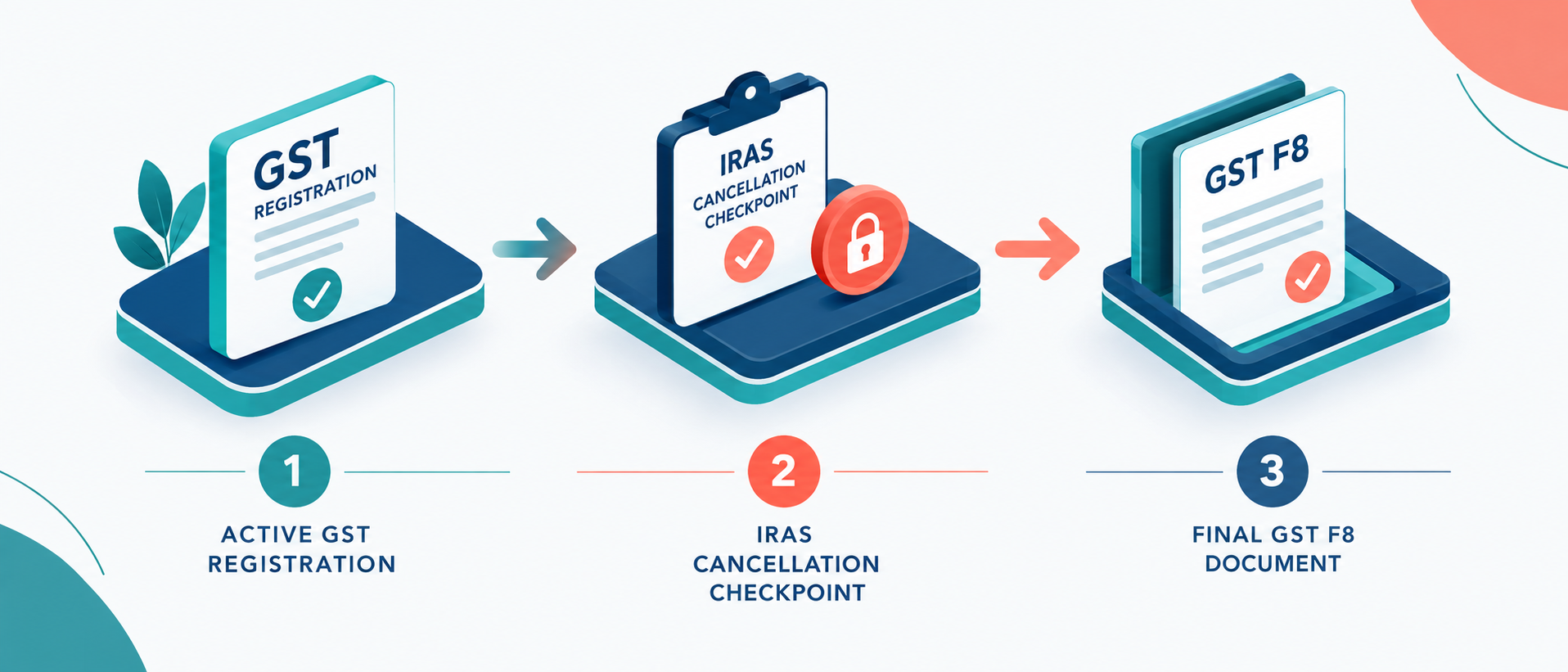
- GST obligations continue until the day before the cancellation date, followed by a final GST F8 return and any required output tax on assets.[1][4]
- Late filing and unpaid GST can attract penalties even after business activity has stopped.[5]
GST deregistration in Singapore is the IRAS process that cancels a business’s GST registration when cancellation is compulsory or the business qualifies to apply voluntarily; IRAS requires compulsory cancellation applications within 30 days after specified events such as business cessation, a complete transfer of the business or a change in business entity.[1] A fall in revenue alone does not automatically cancel GST registration. The business must assess continuing registration liability, obtain IRAS approval, comply until the effective cancellation date and file its final GST F8 return.
What is GST deregistration in Singapore?
GST deregistration is the formal cancellation of a person’s GST registration by IRAS. The Goods and Services Tax Act 1993 authorises the Comptroller to cancel registration when the statutory conditions are satisfied.[3]
GST deregistration changes the business’s indirect-tax status. GST deregistration does not automatically close the company, strike it off ACRA’s register or end its corporate income tax, accounting, payroll and corporate secretarial obligations.
IRAS uses the term “cancellation of GST registration” in its guidance. Businesses commonly use “GST deregistration” and “GST de-registration” to describe the same process.
When is GST deregistration compulsory?
GST deregistration is compulsory when a registered business meets one of IRAS’s mandatory cancellation conditions. IRAS requires the business to apply within 30 days when it has stopped making taxable supplies with no intention of making them in future, ceased business, transferred the whole business to another person, or changed its form of business entity.[1]
A business conversion can create two separate GST questions. The former entity may need its registration cancelled, while the new entity must separately determine whether it is liable to register for GST.[1][2]
A transfer of the entire business creates a similar distinction. The transferor’s cancellation does not determine the transferee’s registration position, so the buyer must assess whether the acquired turnover and future activities create a GST registration obligation.[1][2]
When can a business apply for voluntary GST deregistration?
A business may apply voluntarily when it is no longer liable for GST registration. IRAS allows cancellation where the business can establish that its taxable turnover for the next 12 months will be S$1 million or less because of specific circumstances and the business is no longer liable under reverse charge.[1][2]
IRAS expects evidence supporting the projected reduction. IRAS identifies circumstances such as the termination of a high-value customer contract or large-scale downsizing and requires supporting documentation for the next-12-month turnover projection.[1]
A voluntarily registered business must generally remain registered for at least two years before applying for cancellation.[1] The two-year condition prevents a business from entering and leaving the GST system solely for short-term input-tax advantages.
How do compulsory and voluntary GST deregistration compare?
Compulsory GST deregistration follows a specified cessation or restructuring event, while voluntary GST deregistration depends on the business no longer being liable to register. The following comparison identifies the practical differences.[1][2]
| Issue | Compulsory GST deregistration | Voluntary GST deregistration |
|---|---|---|
| Trigger | Business cessation, permanent cessation of taxable supplies, whole-business transfer or change in business entity[1] | Business remains active but is no longer liable for GST registration[1] |
| Application deadline | Application must be made within 30 days after the relevant event[1] | No equivalent event-based 30-day deadline applies, but registration continues until IRAS approves cancellation |
| Turnover analysis | Turnover may be secondary when the business has ceased or stopped taxable supplies permanently | Next-12-month taxable turnover and any reverse-charge liability are central[1][2] |
| Supporting basis | Cessation, transfer or entity-change evidence | Specific circumstances and documents supporting the turnover projection[1] |
| Voluntary-registration restriction | Restriction may be irrelevant where compulsory cancellation applies | A voluntarily registered business must generally remain registered for at least two years[1] |
| IRAS decision | IRAS confirms approval and the effective date | IRAS assesses whether the business has ceased to be liable and confirms the effective date |
Does turnover below S$1 million automatically allow GST deregistration?
Taxable turnover below S$1 million does not automatically cancel GST registration or guarantee approval of voluntary deregistration. IRAS requires a forward-looking assessment and supporting evidence showing that taxable turnover for the next 12 months will be S$1 million or less because of specific circumstances.[1]
IRAS’s compulsory registration framework uses a S$1 million taxable-turnover threshold under both retrospective and prospective tests.[2] Taxable turnover includes standard-rated and zero-rated supplies but excludes exempt supplies, out-of-scope supplies and sales of capital assets.[2]
A temporary decline, unsupported sales forecast or management target may provide insufficient support. A business should connect its lower projection to evidence such as a terminated contract, discontinued business line, premises closure, documented downsizing or another identifiable commercial event.
What documents support a GST deregistration application?
A GST deregistration application should include records that prove the cancellation ground and support every turnover or asset figure supplied to IRAS. The exact documents depend on whether the application is compulsory or voluntary.[1]
| Application issue | Useful supporting records | Purpose |
|---|---|---|
| Business cessation | Cessation resolutions, final invoices, terminated leases, employee-cessation records and closure accounts | Establishes that business activity and taxable supplies have stopped |
| Whole-business transfer | Sale agreement, asset schedule and transfer date documentation | Establishes the event requiring cancellation and supports the transferee’s separate analysis |
| Change in entity | ACRA records, incorporation documents and transfer accounts | Distinguishes the former entity from the new entity |
| Lower future turnover | Signed contract termination, customer correspondence, board-approved downsizing plan and detailed forecast | Substantiates the next-12-month taxable-turnover projection required by IRAS[1] |
| Reverse-charge analysis | Overseas supplier ledger, imported-services records and input-tax recovery analysis | Establishes whether registration liability continues under reverse charge[2] |
| Closing assets | Fixed-asset register, inventory listing, input-tax records and market-value evidence | Supports output-tax calculations in the final GST F8[1] |
| Uncompleted supplies | Contracts, delivery records, work-in-progress schedules, invoices and payment records | Identifies supplies spanning the effective cancellation date[1] |
| Outstanding compliance | GST return history, payment statements and reconciliations | Confirms that earlier filing and payment obligations are complete |
How do you apply for GST deregistration?
An authorised person applies for GST deregistration through myTax Portal after confirming the business’s cancellation basis and preparing the supporting records. A controlled process reduces the risk of an incorrect effective date or incomplete final return.[1]
- Identify the cancellation ground. Classify the application as compulsory or voluntary and record the date on which the relevant event occurred.
- Reassess registration liability. Test taxable turnover under the applicable IRAS rules and check for reverse-charge or other continuing registration obligations.[2]
- Check the voluntary-registration period. Confirm whether a voluntarily registered business has completed the minimum two-year registration period.[1]
- Prepare the evidence. Compile cessation records, restructuring documents or detailed turnover projections supported by specific commercial events.
- Review closing transactions. Identify unbilled supplies, deposits, credit notes, bad debts, imports and transactions spanning the proposed cancellation date.
- Prepare the closing asset schedule. List inventory, computers, machinery, vehicles, non-residential property and other relevant assets held on the last day of registration.[1]
- Apply through myTax Portal. The person authorised to access myTax Portal and submit GST returns can lodge the online cancellation application.[1]
- Wait for IRAS approval. Continue charging GST and meeting GST obligations until the last day of registration confirmed by IRAS.[1]
- Update invoicing and systems. Stop charging GST and issuing tax invoices from the effective cancellation date.[1]
- File the final GST F8. Report transactions through the final day of registration, account for applicable assets and spanning supplies, and settle outstanding tax.[1][4]
How long does GST deregistration take?
IRAS states that most online GST cancellation applications are approved on the day of application, while some applications take between one and 10 working days. Processing times vary when IRAS needs supporting information or further review.[1]
The application date does not determine when the business can stop charging GST. IRAS notifies the business of the approved effective cancellation date, and the business remains responsible for GST through the day before that date.[1]
A finance team should keep billing, point-of-sale and accounting systems unchanged until the effective date is confirmed. Premature removal of GST can create under-collected tax, while continued collection after cancellation can amount to wrongful GST collection.
What happens on the effective date of GST deregistration?
The business must stop charging and collecting GST from the effective cancellation date. IRAS states that collecting GST after cancellation is an offence, and the business should stop issuing tax invoices from that date.[1]
The business must continue fulfilling all GST obligations through the last day of registration, which is one day before the effective cancellation date.[1] Transactions delivered or performed before cancellation can still require reporting even when the invoice or payment occurs later.
Accounting systems should preserve the approved date as a tax control. Invoice templates, recurring billing rules, e-commerce settings, customer contracts and credit-note procedures should all be updated using the same cut-off.
What is the final GST F8 return?
The GST F8 is the final return that accounts for GST through the last day of the business’s registration. IRAS requires the business to submit the GST F8 and account for GST within one month from the end of the prescribed accounting period stated on the return.[1]
The business must also file all outstanding GST returns and pay outstanding GST.[1] A dormant or inactive period does not remove the filing requirement while the business remains registered.
The GST F8 includes two closing areas that require particular care: business assets held on the last day of registration and supplies delivered or performed before cancellation when invoicing or payment occurs after cancellation.[1][4]
How are business assets treated during GST deregistration?
A business may need to account for output tax at the prevailing rate on qualifying assets held on its last day of GST registration. IRAS applies this treatment when the total open-market value of relevant assets exceeds S$10,000 and input tax was claimed on those assets, including assets obtained through a qualifying transfer of business as a going concern.[1]
Relevant business assets can include non-residential property, computers, machinery, vehicles and unsold inventory.[1] The calculation uses open-market value rather than the original purchase price or net book value.
IRAS provides exceptions where the total open-market value of the relevant assets is S$10,000 or less or the whole business is transferred as a going concern to another GST-registered person.[1] A business should verify every condition before relying on either exception.
What can GST deregistration cost a business?
The principal GST deregistration cost often arises from final output tax, accounting work and compliance corrections rather than the online cancellation request itself. Output tax on qualifying closing assets can create a material payment even where the business has stopped trading.[1]
Additional cost can arise from reconciling incomplete records, valuing inventory and fixed assets, correcting earlier GST returns, reviewing contracts that span the cancellation date and updating invoicing systems. A rushed cancellation can increase these costs when the business lacks a reliable asset register or transaction cut-off.
Late filing or non-payment can add statutory penalties. IRAS may impose a late submission penalty of S$200 immediately for an overdue GST F8 and another S$200 for each completed month it remains outstanding, up to S$10,000 for that return; unpaid tax can also attract a 5% late-payment penalty and further monthly penalties under the stated conditions.[5]
Why can IRAS refuse or delay GST deregistration?
IRAS can refuse or delay GST deregistration when the business remains liable to register or the application does not substantiate its cancellation basis. The Goods and Services Tax Act 1993 gives the Comptroller statutory authority over cancellation decisions.[3]
A voluntary application can fail when the business has not completed the minimum two-year period, still expects taxable turnover above S$1 million, remains liable under reverse charge or relies on an unsupported revenue forecast.[1][2]
An application can also require further review when transaction records, asset schedules or entity-change documents do not match the requested effective date. Clear reconciliations and dated evidence help IRAS test whether the business’s tax position is complete.
What records must a business keep after GST deregistration?
A business must keep proper records of its business transactions for at least five years from the transaction date even after GST registration has been cancelled. IRAS applies the record-retention requirement beyond the cancellation date.[1]
Relevant records include invoices, receipts, credit notes, import documents, contracts, bank records, accounting ledgers, asset registers, inventory records, GST computations and correspondence supporting the cancellation application.
Company closure does not justify destroying records early. Directors, liquidators and finance teams should establish who will retain the records and how IRAS can access them throughout the retention period.
How does GST deregistration affect a continuing business?
A continuing business loses the right to charge GST and generally loses the ability to claim input tax after the effective cancellation date. Pricing, customer contracts and procurement assumptions should be reviewed before the transition.
A business selling mainly to GST-registered customers may find that deregistration changes the commercial presentation of its prices. A business selling mainly to consumers may gain flexibility in tax-inclusive pricing, but the business will bear GST charged by suppliers as a cost where no recovery is available.
A business should continue monitoring turnover after cancellation. A later increase in taxable turnover can create a fresh compulsory registration obligation under IRAS’s retrospective or prospective tests.[2]
How would GST deregistration work for a downsizing company?
A downsizing company can apply voluntarily when specific evidence supports taxable turnover of S$1 million or less for the next 12 months and no other registration liability continues. Consider an anonymised Singapore company whose past-calendar-year taxable turnover was S$1.2 million but whose principal S$700,000 customer contract has been terminated.
The company prepares the termination notice, revised sales pipeline, management accounts and a detailed next-12-month turnover forecast of S$500,000. The company also checks that reverse-charge liability does not require continued registration and confirms that any voluntary-registration minimum period has been completed.[1][2]
The company applies through myTax Portal but continues charging GST until the confirmed last day of registration. The finance team then files GST F8, values closing inventory and equipment, accounts for applicable spanning supplies and updates its invoice templates from the effective cancellation date.[1]
Approval is not guaranteed. IRAS assesses whether the evidence substantiates the forecast and whether the company has ceased to be liable for registration.
How can E&H Corporate Services support GST deregistration?
E&H Corporate Services can coordinate the accounting, tax and corporate records needed for an orderly GST deregistration. The work can include registration-liability analysis, turnover projections, asset-register review, final GST F8 preparation and accounting-system cut-off controls.
Planning to cancel a GST registration? E&H Corporate Services can review the cancellation basis, closing assets and outstanding GST filings before the application is submitted, then align the approved cancellation date with the company’s bookkeeping, invoicing and corporate compliance.
Frequently Asked Questions
Can a company deregister from GST when turnover falls below S$1 million?
A company may apply when it is no longer liable to register and can substantiate taxable turnover of S$1 million or less for the next 12 months because of specific circumstances. A turnover decline does not cancel registration automatically.[1][2]
Must a voluntarily registered business stay registered for two years?
A voluntarily registered business must generally remain registered for at least two years before applying for cancellation.[1]
How quickly does IRAS approve GST deregistration?
IRAS states that most online applications are approved on the application day, while some cases take one to 10 working days.[1] Processing times vary when additional review is required.
When should a business stop charging GST?
A business should stop charging GST from the effective cancellation date notified by IRAS. GST obligations continue through the preceding day.[1]
Does a deregistered business still need to file a GST return?
A deregistered business must file the final GST F8 and all outstanding GST returns. GST F8 is due within one month from the end of the prescribed accounting period stated on the return.[1]
Is GST payable on assets after deregistration?
Output tax may apply to qualifying assets held on the last day of registration when their total open-market value exceeds S$10,000 and the relevant input-tax conditions are met.[1]
Can IRAS reject a GST deregistration application?
IRAS can refuse cancellation when the business remains liable or eligible to be registered under the applicable statutory framework.[3] An unsupported turnover forecast or continuing reverse-charge liability can prevent voluntary cancellation.[1][2]
Must records be retained after GST deregistration?
Business records must be retained for at least five years from the transaction date even when GST registration has already been cancelled.[1]
Related reading
- GST Registration in Singapore: Requirements, Process, Costs and Filing Guide
- GST in Singapore: Rates, Registration, Exemptions and Filing
- Must a dormant GST-registered business file a return?
- How long must GST records be retained?
- How long must a voluntary GST registrant remain registered?