
Understand corporate tax filing in Singapore, including ECI, Form C-S or Form C, deadlines, records, XBRL, tax calculations, costs and compliance steps.
TLDR:
- Singapore companies should maintain complete accounts and supporting tax records throughout each financial year.
- IRAS may require a company to submit Estimated Chargeable Income before its annual income tax return.[1]
- Companies complete annual corporate tax filing through Form C-S, Form C-S (Lite) or Form C, depending on eligibility.[2]
- ACRA annual return and financial statement obligations remain separate from IRAS tax filing obligations.[3]
- Filing costs depend on transaction volume, accounting quality, tax complexity, XBRL needs and professional support.
Under the Income Tax Act 1947, a Singapore company must file an annual corporate income tax return with IRAS for each Year of Assessment (YA), reporting its chargeable income and paying tax on it.
Corporate tax filing in Singapore is the process through which a company reports its income, deductions and chargeable income to the Inland Revenue Authority of Singapore (IRAS). A complete filing cycle normally involves finalising accounts, reviewing the Estimated Chargeable Income obligation, preparing a tax computation, submitting the applicable annual corporate income tax form and settling the assessed tax.[1][2] Singapore corporate tax filing is therefore an annual compliance process rather than a single form completed at year-end.
What does corporate tax filing in Singapore include?
Corporate tax filing includes accounting close, tax adjustments, ECI review, annual return submission, assessment review and tax payment.
Accounting profit does not automatically equal chargeable income. A company must start with its financial results and apply the relevant tax treatment to revenue, expenses, capital items, allowances, losses and exemptions.
Corporate tax filings commonly involve the following work:
- Closing the accounting records for the financial year.
- Reconciling bank, payroll, sales, purchasing and balance-sheet accounts.
- Preparing financial statements or management accounts.
- Reviewing whether an ECI filing is required.
- Preparing a detailed tax computation.
- Selecting the correct annual tax form.
- Submitting supporting schedules when required.
- Reviewing the Notice of Assessment issued by IRAS.
- Paying tax by the stated deadline or arranging an available payment plan.
A company should treat each activity as part of one compliance workflow. Incomplete bookkeeping can flow into the tax computation, produce incorrect declarations and delay the company’s response to IRAS queries.
Which companies must file corporate taxes in Singapore?
Singapore-incorporated companies should assess their corporate income tax obligations for every Year of Assessment, including companies with losses or no current tax payable.
A company’s filing position depends on its activities, financial results, IRAS filing status and any applicable waiver or exemption. Dormancy, losses, low revenue and the absence of tax payable should not be treated as automatic confirmation that no submission is needed.
Newly incorporated companies should establish their first financial year end before building a compliance calendar. The chosen financial year end affects the accounting period, the relevant Year of Assessment and the sequencing of tax and ACRA filings.
Foreign-owned Singapore companies follow the Singapore filing process applicable to their local entity. Ownership by overseas shareholders does not remove the need to maintain suitable accounting records and review local tax obligations.
What are ECI, Form C-S, Form C-S (Lite) and Form C?
ECI is an early estimate of chargeable income, while Form C-S, Form C-S (Lite) and Form C are annual corporate income tax returns with different eligibility and reporting requirements.
IRAS maintains separate guidance for ECI and annual corporate income tax returns.[1][2] Companies should confirm current eligibility through official IRAS guidance before selecting a form.
| Filing | Purpose | Practical preparation |
|---|---|---|
| Estimated Chargeable Income (ECI) | ECI provides IRAS with an estimate of the company’s chargeable income for the relevant period. | The company closes or estimates its accounts, applies tax adjustments and checks whether an ECI waiver applies. |
| Form C-S (Lite) | Form C-S (Lite) provides a simplified annual return for companies meeting the applicable conditions. | The company confirms eligibility and retains the accounts and computations supporting every declaration. |
| Form C-S | Form C-S provides a simplified annual return for qualifying companies. | The company prepares an accurate tax computation even when supporting documents are not submitted with the form. |
| Form C | Form C provides the full annual corporate income tax return for companies outside the simplified filing routes or otherwise required to use it. | The company prepares the return, tax computation, financial information and applicable schedules. |
Form selection should occur after the accounts and tax computation have been reviewed. Revenue alone may not resolve every eligibility question.
What documents are needed for company tax filing?
A company needs complete accounting records, supporting documents and schedules that explain how financial profit became chargeable income.
A practical corporate tax filing file usually contains:
- Trial balance, general ledger and chart of accounts.
- Profit and loss statement and balance sheet.
- Bank statements and bank reconciliations.
- Sales invoices, supplier invoices and credit notes.
- Expense receipts and employee reimbursement records.
- Payroll reports, CPF records and staff benefit details.
- Fixed asset register and supporting purchase documents.
- Loan agreements and interest schedules.
- Related-party transaction records.
- Prior-year tax computations and Notices of Assessment.
- Details of unutilised losses, donations and capital allowances.
- Tax incentive, exemption or rebate information where relevant.
- Withholding tax and foreign income records where relevant.
Document quality matters as much as document availability. A ledger entry labelled only as “general expense” rarely provides enough information to determine the correct tax treatment.
Finance teams should record the business purpose of unusual or material expenses when each transaction occurs. Contemporaneous explanations reduce year-end queries and help advisers distinguish revenue expenses from capital or private items.
How do companies complete corporate tax filing?
Companies complete corporate tax filing by closing the accounts, calculating tax adjustments, meeting the applicable ECI obligation and submitting the correct annual return.
- Confirm the financial year end. Record the accounting period covered and map it to the appropriate Year of Assessment.
- Complete the bookkeeping. Post all sales, purchases, payroll, bank, loan, asset and year-end adjustment entries.
- Reconcile control accounts. Match bank balances, customer balances, supplier balances, payroll liabilities, director accounts and tax accounts to supporting records.
- Prepare the financial results. Produce the trial balance, profit and loss statement, balance sheet and supporting schedules.
- Review the ECI obligation. Check the current IRAS requirements, determine whether a waiver applies and submit ECI when required.[1]
- Calculate tax adjustments. Identify non-deductible expenses, capital expenditure, capital allowances, taxable income, available losses and applicable reliefs.
- Prepare the tax computation. Reconcile accounting profit or loss to chargeable income in a clear working paper.
- Select the annual return. Confirm whether the company qualifies for Form C-S (Lite), Form C-S or must use Form C.[2]
- Submit the return through the authorised channel. An authorised company officer or appointed tax agent should review the declaration before submission.
- Review the assessment. Compare the IRAS Notice of Assessment with the filed computation and investigate any difference promptly.
- Arrange payment and archive the file. Record the payment deadline and preserve the filed return, computation, accounts and supporting schedules.
When are Singapore corporate tax filings due?
Corporate tax deadlines depend on the company’s financial year end, Year of Assessment, filing requirement and the current timetable published by IRAS.
IRAS publishes the applicable ECI rules and annual filing arrangements on its corporate income tax pages.[1][2] Companies should verify the live deadlines rather than rely on an old calendar, prior-year email or previous filing date.
| Compliance event | Timing trigger | Recommended internal control |
|---|---|---|
| Accounting close | Financial year end | Set a bookkeeping cut-off and collect missing documents immediately. |
| ECI review | End of the financial year | Determine the filing or waiver position as soon as preliminary accounts are available. |
| Annual corporate tax return | Applicable Year of Assessment | Schedule preparation before the official deadline and allow time for management review. |
| Notice of Assessment review | IRAS issuance | Compare the assessment with the submitted return upon receipt. |
| Tax payment | Due date stated by IRAS | Obtain approval and arrange sufficient cash before the payment date. |
| ACRA annual return | Company-specific corporate filing cycle | Maintain a separate ACRA deadline because an IRAS filing does not complete the ACRA obligation. |
A compliance calendar should assign an owner to every deadline. Shared responsibility without a named owner often leads to late document collection and rushed declarations.
How is corporate income tax calculated?
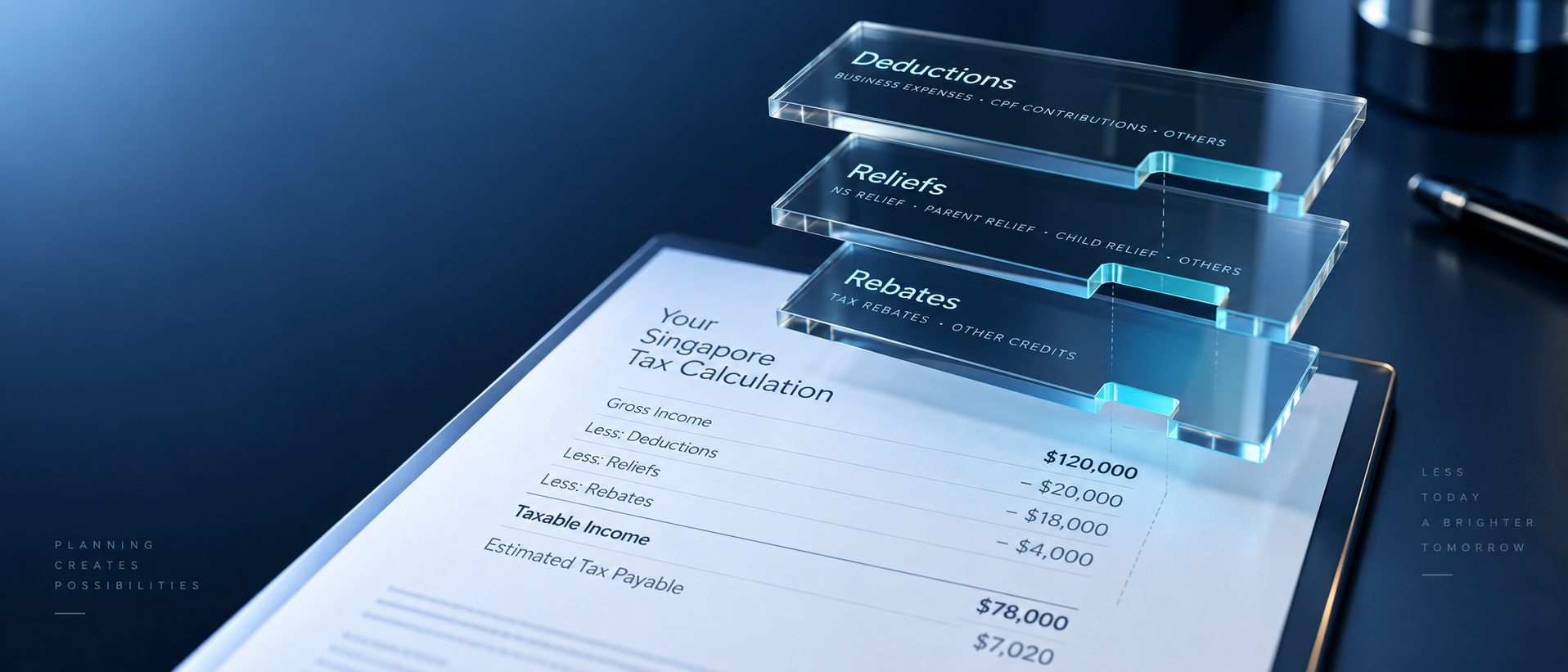
Corporate income tax is calculated by adjusting accounting profit for tax purposes, applying available deductions and reliefs, and then applying the prevailing tax rate to chargeable income.
IRAS publishes the prevailing corporate income tax rate and related rate information on its official corporate income tax page.[4] Companies should use the rate applicable to the relevant Year of Assessment.
A simplified calculation follows this structure:
Accounting profit or loss
+ Non-deductible expenses and taxable adjustments
− Non-taxable items and allowable deductions
− Capital allowances, qualifying donations or available losses where applicable
= Chargeable income before applicable exemptions
− Applicable tax exemptions
= Chargeable income subject to the prevailing rate
− Applicable rebates or credits
= Net corporate income tax payable
Common review areas include private expenses, penalties, provisions, depreciation, fixed asset purchases, financing costs, staff benefits, motor vehicle expenses and related-party charges. Tax treatment depends on the nature and purpose of each item rather than its account name alone.
Depreciation recorded in financial statements generally requires separate tax analysis. Fixed asset expenditure may instead be considered under the applicable capital allowance rules.
Which tax exemptions and rebates may reduce company tax?
Qualifying companies may reduce their tax through applicable exemption schemes, rebates, deductions, capital allowances, losses and credits.
IRAS publishes the qualifying conditions and chargeable-income bands for company tax exemption schemes.[5] Companies should test every condition for the relevant Year of Assessment instead of assuming that incorporation date alone creates entitlement.
IRAS also publishes corporate income tax rebates by Year of Assessment, including any applicable cap or additional component.[6] Budget measures can change between years, so finance teams should apply only the relief announced for the filing period concerned.
A tax exemption reduces the part of chargeable income subject to tax. A rebate generally reduces tax calculated after applying the relevant rate. The distinction matters because the same nominal amount can produce a different result depending on where it enters the computation.
A company should keep a separate schedule for each relief claimed. The schedule should identify the legal entity, Year of Assessment, source amount, amount used, amount carried forward and supporting evidence.
How do IRAS tax filing, ACRA annual returns and XBRL differ?
IRAS tax filing reports the company’s tax position, while ACRA annual return and XBRL obligations form part of corporate reporting and statutory filing.
ACRA publishes annual return and financial statement filing requirements, including the circumstances affecting XBRL submissions.[3] IRAS also provides guidance on XBRL in the corporate income tax filing context.[7] Companies should review both authorities because completing one filing does not automatically complete the other.
| Compliance item | Authority | Main purpose | Key distinction |
|---|---|---|---|
| ECI | IRAS | Reports an estimate of chargeable income where required. | ECI precedes the final annual tax position. |
| Form C-S (Lite), Form C-S or Form C | IRAS | Reports the annual corporate income tax position. | The return uses tax rules and tax adjustments. |
| Annual return | ACRA | Updates required corporate information and completes the annual corporate filing. | The annual return is not a corporate income tax return. |
| Financial statements and XBRL | ACRA or the applicable filing context | Presents financial information in the required format. | XBRL applicability depends on the governing filing requirements. |
| GST return | IRAS | Reports output tax, input tax and net GST for a GST-registered business. | GST reporting follows a separate reporting cycle from corporate income tax. |
Companies should reconcile information across filings. Revenue, profit, assets and company details should not differ without a documented reason.
How much does corporate tax filing cost?
Corporate tax filing costs depend on accounting readiness, transaction volume, entity complexity, tax adjustments and the level of professional work required.
A simple company with reconciled accounts and organised records usually requires less work than a company with incomplete bookkeeping, multiple revenue streams, foreign transactions or unresolved balance-sheet items.
| Cost driver | Why the cost changes |
|---|---|
| Bookkeeping condition | Missing entries and unreconciled accounts require correction before tax work can begin. |
| Transaction volume | More transactions increase review and reconciliation work. |
| Number of bank and payment accounts | Each account requires complete records and reconciliation. |
| Fixed assets | Asset additions, disposals and capital allowance schedules require separate analysis. |
| Related-party transactions | Intercompany charges and balances require support and consistency checks. |
| Overseas activity | Foreign income, withholding taxes and cross-border expenses may require additional review. |
| Form type | A full return can require more schedules and supporting information than a simplified return. |
| XBRL or statutory accounts | Financial reporting work may be priced separately from the corporate tax return. |
| Prior-year corrections | Historical errors can affect opening balances, losses and current-year tax treatment. |
Professional fees and corporate income tax payable are separate amounts. A service quote covers preparation or advisory work, while the company pays its assessed tax liability to IRAS.
What corporate tax filing mistakes should companies avoid?
Companies should avoid filing from incomplete accounts, claiming unsupported deductions, using the wrong return and overlooking separate compliance deadlines.
Common corporate tax filing mistakes include:
- Treating every business-booked expense as automatically deductible.
- Claiming fixed asset purchases as ordinary operating expenses without tax analysis.
- Omitting income because cash was received after the financial year end.
- Leaving director or related-party balances unreconciled.
- Using an outdated filing threshold, form or deadline.
- Assuming that losses remove every filing obligation.
- Ignoring ECI because the annual return will be filed later.
- Confusing the ACRA annual return with the IRAS tax return.
- Filing before payroll, bank and revenue records are complete.
- Failing to compare the Notice of Assessment with the submitted computation.
- Losing schedules that support losses, allowances, donations or reliefs carried forward.
A pre-filing review should trace major figures from source records to the accounts, from the accounts to the tax computation and from the tax computation to the return. The audit trail makes errors easier to identify before submission.
How can a company improve its corporate tax filing process?
A company can improve filing quality by replacing year-end document collection with monthly bookkeeping, reconciliations and a documented tax close.
Consider an illustrative Singapore trading company that records sales monthly but updates supplier invoices only near year-end. The first draft accounts show a profit, yet bank reconciliations identify unrecorded purchases and customer refunds. A fixed asset review also finds equipment posted entirely to office expenses.
The company corrects the ledger, updates the fixed asset register and prepares a tax adjustment schedule before filing. The revised workflow produces financial statements that agree with the bank records and a tax computation that explains each adjustment.
The example demonstrates the value of accounting readiness. Tax preparation cannot reliably correct a full year of weak recordkeeping within a few hours.
How should businesses prepare for the next filing cycle?
Businesses should maintain monthly accounts, preserve supporting documents and review tax-sensitive transactions before year-end.
A practical preparation checklist includes:
- Confirm the financial year end and relevant Year of Assessment.
- Assign responsibility for bookkeeping, ECI, annual tax and ACRA filing.
- Reconcile every bank and payment account monthly.
- Maintain a current fixed asset register.
- Record the purpose of material and unusual expenses.
- Resolve director and related-party balances before year-end.
- Review contracts involving overseas payments or foreign income.
- Track losses, capital allowances, donations and credits by year.
- Schedule management review before submission.
- Archive the acknowledgement and final filing package.
Consistent monthly controls reduce filing risk and provide management with more reliable information for cash flow, budgeting and business decisions.
How can E&H Corporate Services support corporate tax compliance?
E&H Corporate Services can coordinate accounting, tax preparation and related statutory compliance for Singapore companies.
Corporate tax filing support E&H Corporate Services helps business owners organise their bookkeeping, close annual accounts, prepare tax computations and coordinate corporate filings. Integrated accounting, corporate secretarial, tax, GST and payroll support reduces gaps between financial records and regulatory submissions. Request a scope review before the filing period so that missing records, historical balances and complex transactions can be addressed early.
Frequently Asked Questions
The following answers address common questions from founders, directors and finance teams.
Does a company with no profit still need to review its filing obligations?
A loss-making or inactive company should still check its ECI and annual return position for the relevant Year of Assessment. A lack of profit does not by itself confirm that every filing requirement has been waived.
Can a company file corporate tax before completing its accounts?
Reliable filing requires sufficiently complete accounts because revenue, expenses, assets and liabilities feed into the tax computation. Preliminary figures may support an estimate, but the annual return should reflect an appropriately reviewed tax position.
What is the difference between accounting profit and chargeable income?
Accounting profit follows the company’s financial reporting records, while chargeable income reflects tax adjustments, allowable deductions, capital allowances, losses and applicable exemptions.
Can a director file the company tax return?
An authorised person may submit the return through the applicable IRAS process. Company management remains responsible for providing complete information and approving accurate declarations.
Does Form C-S mean that no tax computation is needed?
Form C-S is a simplified return, but the company still needs records and calculations supporting the figures declared. Simplified submission does not remove the need for an accurate tax position.
Is an ACRA annual return the same as a corporate tax return?
An ACRA annual return is a corporate filing, while Form C-S, Form C-S (Lite) or Form C reports corporate income tax information to IRAS. Each filing has a separate purpose.
Does a tax agent guarantee that IRAS will accept every claim?
Professional preparation improves filing quality, but acceptance of a deduction, relief or tax position depends on the applicable rules and supporting facts. IRAS may request information or adjust an assessment.
What should a company do after receiving a Notice of Assessment?
Company management should compare the assessment with the filed return, confirm the payment deadline and raise any discrepancy promptly through the applicable IRAS process.
How early should corporation tax filing preparation begin?
Preparation should begin during the financial year through monthly bookkeeping and reconciliations. Year-end work should focus on closing and review rather than reconstructing transactions.
Can E&H Corporate Services handle accounting and company tax filing together?
E&H Corporate Services can provide an integrated scope covering bookkeeping, annual accounts, corporate tax preparation and related compliance, subject to the company’s records and requirements.
Related reading
- Corporate Tax Advisory Services in Singapore
- Corporate Secretarial Services in Singapore
- What happens if there are errors in filing tax returns in Singapore?
- Can a dormant Singapore company apply for an IRAS tax filing waiver?
- What is the penalty for late tax filing in Singapore?
- What are the Corporate Income Tax (CIT) rebates available to all companies?
- Why and when should companies file ECI?
- What is Estimated Chargeable Income (ECI) and who needs to file it?
- When is the ECI filing deadline?
- Is foreign-sourced income of a Singapore company taxed in Singapore?
Sources & References
- Estimated Chargeable Income (ECI) — Inland Revenue Authority of Singapore
- Form C-S / Form C Filing — Inland Revenue Authority of Singapore
- Filing Requirements for Annual Returns — Accounting and Corporate Regulatory Authority
- Corporate Income Tax Rate — Inland Revenue Authority of Singapore
- Tax Exemption Schemes for Companies — Inland Revenue Authority of Singapore
- Corporate Income Tax Rebate — Inland Revenue Authority of Singapore
- XBRL Filing — Inland Revenue Authority of Singapore