
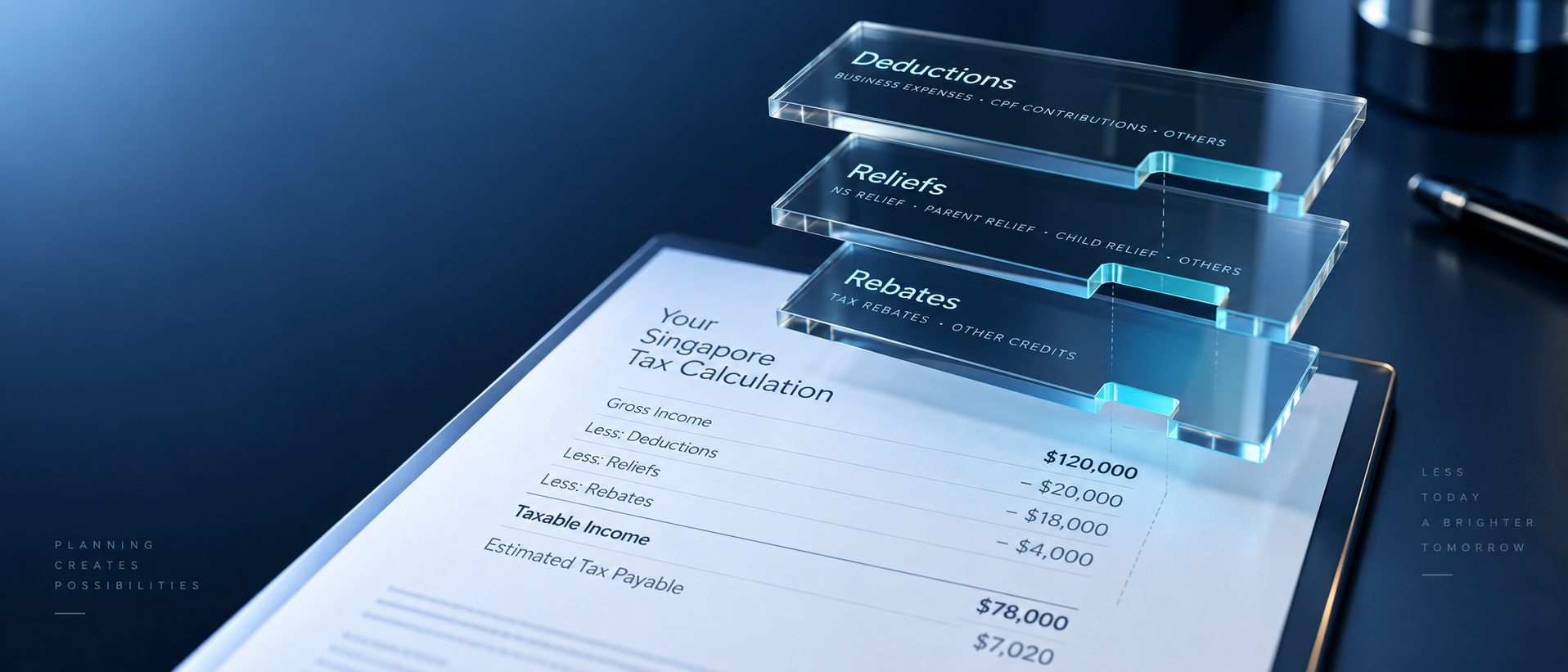
Understand tax relief in Singapore for individuals and companies, including IRAS reliefs, deductions, rebates, claim steps and key compliance risks.
TLDR:
- Singapore tax relief reduces an eligible individual's assessable income, while a tax rebate reduces tax payable.
- Companies generally claim allowable business deductions rather than personal IRAS reliefs.
- Eligibility depends on the taxpayer, expense, contribution, dependant and relevant Year of Assessment.
- An overall cap limits the personal income tax relief an individual can receive.
- Business owners should keep invoices, payroll records and supporting documents for every deduction claimed.
For Year of Assessment 2026, tax relief in Singapore is an IRAS-recognised reduction of an eligible individual's assessable income under the Income Tax Act 1947 before personal income tax is calculated.[1] The correct tax-saving treatment depends on whether the claimant is an employee, a self-employed person or a company: individuals may qualify for personal reliefs, while businesses generally deduct allowable expenses incurred in producing income.[2] Tax rebates operate separately by reducing tax payable rather than assessable income.[1] E&H Corporate Services helps founders and finance teams distinguish personal IRAS reliefs from corporate deductions, prepare supporting records and file the appropriate tax computations.
What does tax relief mean in Singapore?
Singapore tax relief reduces assessable income when a taxpayer meets the applicable IRAS conditions.
IRAS groups personal tax reliefs with rebates and deductions, but the categories produce different results.[1] A relief reduces assessable income, a deduction generally removes an allowable expense or qualifying amount from income, and a rebate reduces the final tax payable.
Tax relief does not create a dollar-for-dollar tax saving. The actual saving depends on the amount allowed and the taxpayer's applicable tax rate.
Companies do not claim personal reliefs such as Spouse Relief or Parent Relief. Companies calculate taxable profits after applying allowable deductions, capital allowances and other applicable tax treatments.
How do reliefs, deductions and rebates differ?
Each tax-saving category applies at a different stage of the Singapore tax calculation.
| Category | Primary users | Tax effect | Common context |
|---|---|---|---|
| Personal tax relief | Qualifying individuals | Reduces assessable income | Earned income, family support, eligible contributions or qualifying course fees |
| Employment deduction | Employees with qualifying expenses | Reduces employment income | Expenses incurred in carrying out employment duties |
| Self-employed deduction | Sole proprietors and partners | Reduces business income | Expenses incurred in producing business income[3] |
| Corporate deduction | Singapore companies | Reduces taxable business profits | Revenue expenses incurred in producing income[2] |
| Tax rebate | Qualifying individuals | Reduces tax payable | Parenthood Tax Rebate and other rebates provided for an applicable Year of Assessment |
| Capital allowance | Businesses with qualifying fixed assets | Provides tax deductions under the applicable capital allowance rules | Plant, machinery and other qualifying assets |
Correct classification matters because an expense cannot be converted into a personal relief merely because the taxpayer paid it personally. Finance teams should identify the taxpayer, legal basis and supporting evidence before entering any amount in a return.
Who can claim IRAS tax relief?
Eligible individuals can claim IRAS reliefs when they satisfy the conditions for the relevant relief and Year of Assessment.
Employees may review reliefs and deductions relating to earned income, CPF contributions, approved course fees, qualifying dependants and eligible donations.[4] Self-employed individuals may also deduct qualifying business expenses when calculating income from their trade, business, profession or vocation.[3]
Company shareholders and directors cannot treat company expenditure as personal tax relief. A company must assess expenditure under the corporate deduction rules, while the individual must assess personal relief eligibility separately.
Tax residency can affect an individual's access to personal reliefs. Taxpayers should confirm their status and the current IRAS conditions instead of assuming that employment or physical presence automatically creates eligibility.
Which personal tax reliefs may be available?
Common IRAS reliefs cover earned income, qualifying contributions, education and family responsibilities.
| Relief category | General purpose | Review point before claiming |
|---|---|---|
| Earned Income Relief | Recognises income from employment, pension or trade | Confirm the applicable category and amount for the relevant Year of Assessment[5] |
| Course Fees Relief | Covers qualifying fees for approved education or professional development | Confirm that the course and payment satisfy the current IRAS conditions[6] |
| CPF Relief | Covers qualifying compulsory or voluntary CPF contributions | Reconcile the claim against CPF records and applicable limits[7] |
| CPF Cash Top-up Relief | Covers qualifying cash top-ups under the applicable scheme | Identify the recipient, account type and source of funds[7] |
| Life Insurance Relief | Applies in limited circumstances under IRAS rules | Review CPF contribution levels and qualifying premiums before claiming[7] |
| Spouse Relief | Supports taxpayers with a qualifying spouse | Check the relationship, support and income conditions[8] |
| Parent Relief | Supports taxpayers maintaining a qualifying parent or other specified dependant | Check residence, support, relationship and income conditions[9] |
| Working Mother's Child Relief | Supports an eligible working mother with a qualifying child | Confirm the child's order, citizenship and current claim basis[10] |
Every relief has its own conditions. Eligibility for one family-related relief does not establish eligibility for another.
How do family-related tax reliefs and rebates work?
Family-related schemes depend on the claimant's relationship to the dependant and the specific IRAS conditions.
Spouse Relief and Parent Relief reduce assessable income when the relevant support, relationship and other qualifying conditions are met.[8][9] Working Mother's Child Relief applies under a separate framework for eligible working mothers and qualifying children.[10]
Parenthood Tax Rebate is a rebate rather than a personal tax relief. Parenthood Tax Rebate reduces tax payable for eligible parents of qualifying Singapore Citizen children and follows its own allocation and utilisation rules.[11]
Family members should coordinate claims before filing. Duplicate or inconsistent claims can trigger amendments, additional questions or a revised assessment.
What is the maximum tax relief in Singapore?
IRAS applies an overall personal income tax relief cap in addition to the conditions and limits for individual reliefs.[1]
The maximum usable relief is not simply the sum of every relief listed on a return. The final amount depends on the reliefs for which the taxpayer qualifies, each relief's applicable restriction, the overall cap and the taxpayer's assessable income.
A taxpayer should not incur an expense or make a contribution solely because it appears to generate relief. Cash-flow needs, investment risk, contribution restrictions and the taxpayer's marginal tax rate can materially affect the practical benefit.
The current IRAS page for the relevant Year of Assessment should be checked before calculating the maximum tax relief in Singapore. Published limits and scheme rules can differ between assessment years.
How should taxpayers approach tax relief for 2025 and 2026?
Tax relief for 2025 and tax relief for 2026 must be matched to the correct Year of Assessment and the rules applying to that year.
Search terms such as “tax relief 2025” can refer to income earned in a different calendar year from the filing year. Taxpayers should identify the relevant Year of Assessment before reviewing contributions, dependant conditions or deductible expenses.
IRAS updates its personal relief guidance to identify available reliefs, eligibility rules and applicable caps.[1] A prior-year spreadsheet should never be rolled forward without checking current guidance.
Finance teams should place the Year of Assessment on every working paper. Clear labels prevent payroll records, contribution statements and expense schedules from being attached to the wrong computation.
Which expenses can a Singapore company deduct?
A Singapore company can generally deduct revenue expenses that satisfy the applicable IRAS business-expense conditions.[2]
A deductible business expense must be assessed by reference to its purpose and connection with income production. Common areas for review include employee costs, rent, professional fees, software, insurance, financing costs, repairs and business travel.
Capital expenditure, private expenditure, income tax and expenses prohibited by the applicable tax rules require separate treatment. A payment recorded as an accounting expense does not automatically qualify for an immediate tax deduction.
Business owners should also separate shareholder expenses from company expenses. Personal expenditure paid through a corporate bank account may require reclassification, repayment, payroll treatment or another adjustment.
How should common company expenses be reviewed?
Every company expense should be tested for business purpose, revenue or capital character, timing and documentary support.
| Expense area | Tax review | Records to retain |
|---|---|---|
| Salaries and bonuses | Confirm the employment purpose, accrual timing and payroll treatment | Employment contracts, payroll reports, bank records and approvals |
| Directors' remuneration | Confirm authorisation, timing and reporting treatment | Resolutions, payroll records and payment evidence |
| Rent and utilities | Separate business premises from private or mixed use | Tenancy agreements, invoices and allocation schedules |
| Professional fees | Identify whether the work relates to operations, financing, capital transactions or compliance | Engagement letters, invoices and work descriptions |
| Software and equipment | Distinguish recurring subscriptions from acquired assets | Contracts, invoices, asset registers and payment evidence |
| Travel and entertainment | Document attendees, destination and business purpose | Receipts, itineraries and meeting records |
| Repairs and improvements | Distinguish restoration from capital enhancement | Contractor scopes, invoices and photographs |
| Bad debts | Confirm that the amount is a genuine trade debt and that the tax conditions are addressed | Customer ledger, correspondence and recovery records |
| Donations | Confirm the recipient and applicable deduction treatment | Official receipts and donation records[12] |
IRAS provides separate guidance on deductible and non-deductible business expenses for incorporated companies.[2] Companies should document uncertain items in the tax computation instead of relying solely on the description in the general ledger.
How do deductions work for sole proprietors and partnerships?
Self-employed persons deduct qualifying business expenses from business income rather than claiming those costs as personal reliefs.[3]
A sole proprietorship is not a separate legal entity from its owner, but business and private transactions still require clear separation for tax reporting. Partnerships should maintain records that support the business computation and each partner's allocation.
Mixed-use expenses require a reasonable business allocation supported by records. A private portion does not become deductible merely because the payment came from a business account.
Self-employed persons should keep invoices, receipts, contracts, bank statements and allocation workings. Consistent recordkeeping helps distinguish operating costs from drawings and private consumption.
How are qualifying donations treated for tax?
Qualifying donations can receive tax deduction treatment when the donation and recipient meet the applicable IRAS requirements.[12]
Companies should verify the recipient's status and retain the official donation record. Sponsorships, marketing arrangements and payments involving commercial benefits may require a different analysis from a pure donation.
Individuals should confirm whether eligible donations have been pre-filled in the tax return. Companies should reconcile donation records to the general ledger and tax computation before filing.
Donation deduction rates and extension periods can be time-sensitive. Taxpayers should confirm the treatment for the relevant Year of Assessment rather than applying a historic rate.
How can an individual claim Singapore tax relief?
An individual should identify eligible reliefs, verify pre-filled information and submit only claims supported by current IRAS rules and records.
- Identify the correct Year of Assessment. Match income, payments and dependant circumstances to the period covered by the return.
- Confirm tax residency and taxpayer status. Determine whether the return concerns employment income, self-employment income or both.
- Review pre-filled information. Compare CPF contributions, donations and other available data against source records.
- Test each relief separately. Apply the eligibility rules for earned income, courses, contributions and qualifying family members.
- Check individual limits and the overall cap. Remove unsupported amounts and document any allocation shared with another claimant.
- Enter the claim in the appropriate field. Avoid recording a rebate as a relief or a business expense as a personal relief.
- Review the assessment after filing. Raise an amendment or objection through the appropriate IRAS process if the assessment does not reflect the submitted facts.
- Retain supporting records. Keep documents organised by Year of Assessment in case IRAS requests substantiation.
IRAS provides employee-focused guidance covering the process for claiming tax reliefs and deductions.[4] The taxpayer remains responsible for checking the accuracy of pre-filled and manually entered information.
How should a company claim tax deductions?
A company should reconcile its accounting records, identify tax adjustments and support every material deduction in its tax computation.
- Close the accounting records. Reconcile bank accounts, payroll, receivables, payables and fixed assets.
- Map the profit and loss accounts. Group expenses by tax treatment rather than relying only on accounting labels.
- Identify non-deductible items. Review private, capital, prohibited and insufficiently supported expenditure.
- Separate fixed assets and capital costs. Consider whether capital allowance treatment applies instead of an immediate expense deduction.
- Review related-party transactions. Confirm business purpose, agreements and supporting calculations.
- Reconcile payroll expenses. Match salaries, bonuses, benefits and directors' remuneration to payroll records and approvals.
- Review donations and special deductions. Confirm current eligibility and retain the required evidence.
- Prepare the tax computation. Record each adjustment clearly and cross-reference it to the accounts and supporting schedules.
- Complete an independent review. Check arithmetic, classifications, prior-year balances and consistency with the filed return.
- Archive the tax file. Store the signed accounts, computation, schedules and evidence in a controlled compliance folder.
IRAS distinguishes allowable business expenses from non-deductible expenses in its company guidance.[2] A disciplined tax pack reduces the risk of unsupported deductions and inefficient follow-up work.
What mistakes commonly cause tax relief problems?
Most tax relief errors arise from incorrect classification, duplicated claims, outdated assumptions or missing evidence.
| Common mistake | Why the mistake matters | Better control |
|---|---|---|
| Wrong Year of Assessment | The claim may be matched to the wrong income period | Label every schedule and source document by year |
| Relief and rebate confusion | The amount may be entered at the wrong calculation stage | Maintain separate relief, deduction and rebate schedules |
| Personal and company expense mixing | The company may claim a private cost or omit required treatment | Review shareholder and director accounts monthly |
| Duplicate dependant claims | Multiple family members may report inconsistent claims | Agree allocations before filing |
| Reliance on prior-year limits | The computation may use outdated rules | Check current IRAS guidance annually |
| Unsupported business purpose | A genuine payment may still lack evidence for deduction | Record the commercial purpose when approving the expense |
| Capital cost recorded as an expense | The tax treatment may differ from the accounting entry | Review the fixed asset register before filing |
| Unreviewed pre-filled data | The return may contain incomplete or incorrect information | Reconcile pre-filled amounts to source records |
A year-end review cannot fully repair weak transaction-level evidence. Companies should capture the business purpose and approval trail when an expense is incurred.
How do tax relief decisions affect payroll and company administration?
Personal tax relief, payroll compliance and corporate deductions are connected operationally but must be calculated separately.
An employee's personal relief belongs in the employee's individual tax position. The employer's salary cost belongs in the company's accounts and must be reviewed under the corporate deduction rules.
Founder-paid expenses need prompt classification. A valid company expense paid personally may require reimbursement, while a private expense paid by the company may require repayment or another accounting treatment.
Corporate secretarial records can also support tax positions involving directors' remuneration, benefits, related-party arrangements and major transactions. Board approvals should agree with payroll reports, accounting entries and payment records.
What do practical tax relief reviews look like?
A practical review traces each claimed amount to the correct taxpayer, assessment year, rule and supporting document.
Anonymised example: founder with company and personal claims
A founder paid for professional training, software and family expenses from the same personal card. The review classified the software by business purpose and company reimbursement status, tested the training separately under the applicable personal and business rules, and excluded private family spending from the company computation. The review prevented one payment stream from producing inconsistent claims across two taxpayers.
Anonymised example: growing company with weak expense descriptions
A Singapore company recorded travel, entertainment and consultancy payments under broad ledger descriptions. The finance team added attendee lists, engagement scopes, invoice references and approval records before preparing the tax computation. The improved evidence allowed each expense to be assessed according to its commercial purpose rather than its abbreviated accounting label.
Anonymised example: family members considering dependant reliefs
Two family members intended to claim relief in respect of the same dependant. A pre-filing review checked the applicable conditions and coordinated the intended claims before submission. The review reduced the risk of duplicate or inconsistent reporting.
How can businesses create a reliable annual tax relief checklist?
A reliable checklist assigns responsibility, evidence and review dates across personal and corporate tax work.
- Create separate individual and company workstreams. Prevent personal reliefs from being mixed with corporate deductions.
- Confirm the Year of Assessment. Place the year on every schedule, document request and review note.
- Reconcile accounting and payroll records. Resolve differences before preparing the tax computation.
- Collect contribution and donation records. Match source documents to amounts reported or pre-filled.
- Review dependant claims within the family. Resolve potential overlaps before filing.
- Inspect director and shareholder accounts. Identify personal expenses, reimbursements and outstanding balances.
- Review capital expenditure. Separate fixed assets from recurring operating expenses.
- Update the rulebook. Replace prior-year thresholds and assumptions with current IRAS guidance.
- Document tax judgements. Record why each material or unusual item was included, excluded or adjusted.
- Arrange a final review. Confirm that the return, tax computation, financial statements and supporting schedules agree.
When should E&H Corporate Services review your tax position?
E&H Corporate Services can support businesses that need coordinated accounting, payroll, corporate tax and compliance review.
Need help reviewing tax deductions and compliance records? E&H Corporate Services can help Singapore founders and finance teams reconcile accounts, classify business expenses, prepare tax computations and maintain supporting schedules. Early review is particularly valuable when company funds and founder-paid expenses have become mixed, payroll records do not agree with the ledger, or prior-year tax treatments have been copied forward without verification.
What are the most common questions about tax relief in Singapore?
Singapore taxpayers should distinguish personal reliefs, business deductions and rebates before calculating any tax saving.
What is tax relief in Singapore?
Singapore tax relief is an eligible reduction of assessable income under the applicable IRAS rules.[1]
What is the difference between tax relief and a tax rebate?
Tax relief reduces assessable income, while a tax rebate reduces the tax payable.[1]
Can a Singapore company claim personal tax relief?
A Singapore company cannot claim personal reliefs. A company claims allowable business deductions and other applicable corporate tax treatments.
What is the maximum tax relief in Singapore?
The maximum depends on each eligible relief, its restrictions, the taxpayer's assessable income and the overall personal income tax relief cap.[1]
Can two people claim relief for the same dependant?
Each claimant must follow the allocation and eligibility rules for the specific dependant relief. Family members should coordinate their claims before filing.
Are all company expenses tax-deductible?
Company expenses are not automatically deductible. Each expense must satisfy the applicable tax conditions and receive the correct revenue, capital or non-deductible treatment.[2]
Can a sole proprietor claim both personal relief and business deductions?
A qualifying sole proprietor may claim personal reliefs in the individual return and deduct qualifying business expenses when calculating business income.[3]
Should taxpayers reuse their tax relief 2025 calculations for 2026?
Taxpayers should verify the relevant Year of Assessment, current eligibility conditions and applicable limits before reusing a prior-year calculation.
Does pre-filled information remove the need for review?
Pre-filled information does not remove the taxpayer's responsibility to check the return against supporting records.
What documents support a business deduction?
Invoices, contracts, payment evidence, approval records and documents explaining the business purpose commonly support a deduction review.