
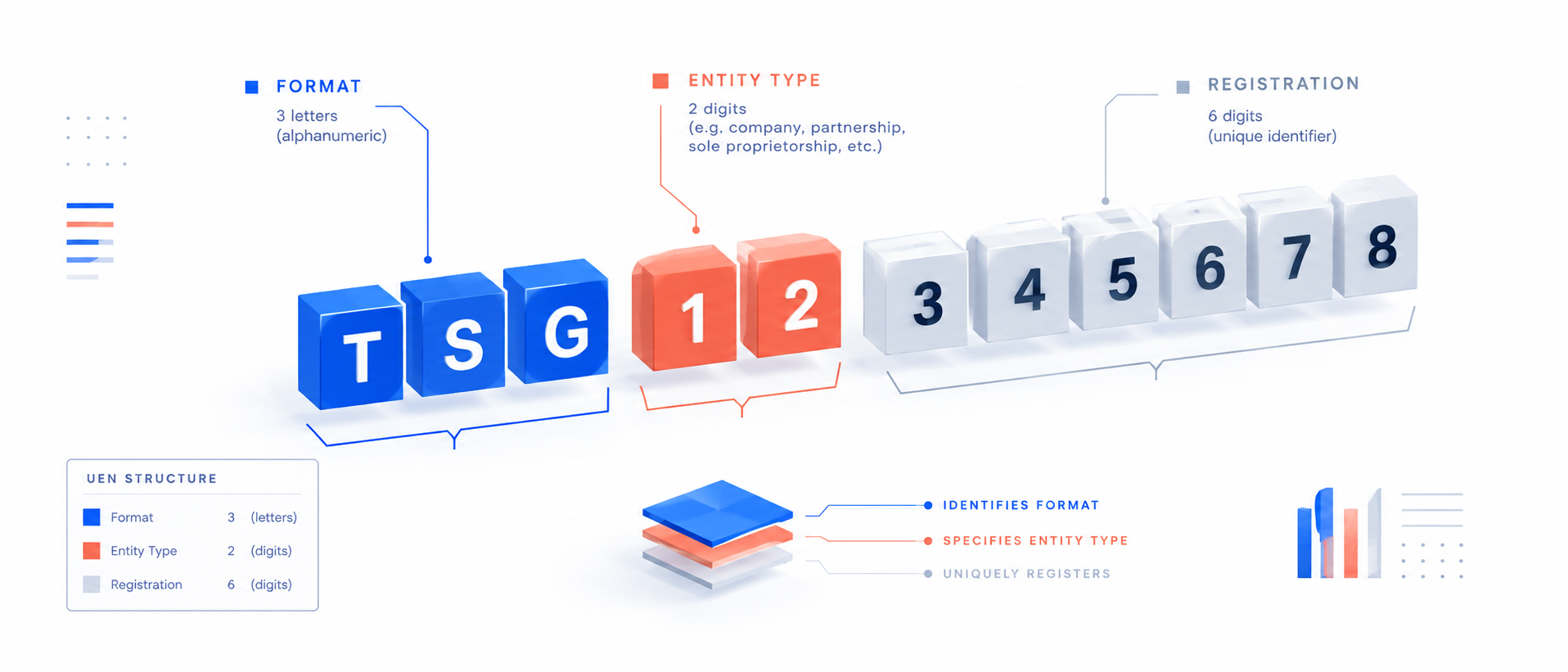
Learn what a Singapore UEN means, who needs one, its formats, where to find it, and how it supports tax, banking, payroll and company compliance.
TLDR:
- UEN stands for Unique Entity Number, the standard identifier Singapore issues to entities registered under the Companies Act and other registration regimes.[1]
- A registered entity receives its UEN from the government agency responsible for registering or recognising that entity.
- The official UEN portal provides a lookup service for checking an entity's registered details.[2]
- A UEN does not by itself prove that an entity is registered for GST; GST status should be checked separately.[3]
- Businesses can use UEN-linked PayNow services for eligible payments, including supported payments to IRAS.[4]
A Unique Entity Number (UEN) is Singapore's standard identification number for an entity that transacts with government agencies, and ACRA confirms that UEN stands for Unique Entity Number.[1] A company, business, partnership, society or other registered organisation generally receives a UEN from its relevant UEN issuance agency during registration or recognition. The UEN number then serves as a consistent reference across government, tax, banking and commercial processes.
Try it: ACRA Company Search
Check any Singapore entity by name or UEN — status, entity type, registration date and registered address, drawn from the official ACRA registry of over 2 million entities.
What does UEN mean in Singapore?
UEN means Unique Entity Number, a permanent identification reference assigned to a registered or recognised entity in Singapore.
The UEN system gives government agencies and businesses a common way to identify an entity without relying only on its name. A legal name can be similar to another organisation's name or may change, while the UEN distinguishes the registered entity in official records.
ACRA describes a UEN as the standard identification number of an entity and explains that the number is issued by the government agency responsible for registering or recognising that entity.[1]
The phrase “UEN number” is widely used in everyday business communication, although the word “number” is already included in “Unique Entity Number.” Both “UEN” and “UEN number” normally refer to the same identifier.
Who needs a UEN?
Entities that are registered, incorporated or otherwise recognised by a Singapore UEN issuance agency generally need and receive a UEN.
ACRA-registered businesses and companies receive UENs as part of their registration records. Other organisations receive UENs from the government agencies that register or recognise their particular entity types.[1]
Common UEN holders include:
- Companies incorporated in Singapore
- Sole proprietorships and partnerships registered with ACRA
- Limited liability partnerships
- Limited partnerships
- Singapore branches of foreign companies
- Societies and associations
- Charities and other registered organisations
- Government bodies and certain public institutions
- Other entities recognised by an authorised UEN issuance agency
An individual does not use a personal UEN merely because the individual is a director, shareholder, employee or customer. The UEN belongs to the registered entity rather than to the people associated with it.
A sole proprietorship is not a separate legal person from its owner. The registered business still has a UEN for business and government transactions. Finance teams should therefore avoid substituting the owner's NRIC or FIN where a counterparty requests the business's UEN.
What formats can a UEN number use?
A UEN can contain nine or ten alphanumeric characters, with its structure depending on the entity category and registration record.
ACRA identifies different UEN structures for businesses, local companies and other entities.[1] The following patterns are schematic illustrations rather than valid UENs.
| Entity category | General pattern | How to read the pattern |
|---|---|---|
| ACRA-registered business | NNNNNNNNX | The UEN contains eight digits followed by a check letter.[1] |
| Local company | YYYYNNNNNX | The UEN contains a four-digit year element, five digits and a check letter.[1] |
| Other entity | TYYPQNNNNX | The UEN contains identifying letters and digits associated with the year and entity type, followed by a check character.[1] |
A UEN should be copied exactly as displayed in the official record. Finance teams should preserve leading letters, year digits, entity-type characters and the final check character.
A format that looks plausible does not prove that a UEN is genuine or active. The official UEN portal should be used to check the entity record before onboarding a supplier, issuing important payments or updating master data.[2]
Is a UEN the same as a business registration number?
A UEN generally serves as the business registration number for an ACRA-registered business or company, but the term UEN covers more entity types than the term business registration number.
A company incorporated through ACRA receives an identification number that functions as its UEN. A sole proprietorship, partnership or other ACRA-registered business also uses its assigned registration identifier as its UEN.
The terms are not perfectly interchangeable across every context. A society, charity or public institution can have a UEN even though it is not an ACRA-registered business. A request for a UEN therefore asks for the official entity identifier, regardless of which UEN issuance agency created the record.[1]
| Term | Practical meaning |
|---|---|
| UEN | The standard identifier used by entities when transacting with Singapore government agencies.[1] |
| Business registration number | A common description for the registration identifier of an ACRA-registered business. |
| Company registration number | A common description for the registration identifier of an incorporated company. |
| GST registration number | A tax reference connected with GST registration; possession of a UEN alone does not establish GST registration.[3] |
Finance teams should request the legal entity name and UEN together. Recording both reduces the risk of capturing a trading name, brand or payment recipient that does not match the registered counterparty.
How does a business get a UEN?
A business obtains a UEN by completing registration or incorporation with the government agency responsible for its entity type.
A standard company or business registration does not normally require a separate UEN application after the entity has been registered. The responsible UEN issuance agency assigns the identifier as part of the completed registration or recognition process.[1]
- Choose the legal structure. The founder selects an appropriate structure, such as a private limited company, sole proprietorship, partnership or limited liability partnership.
- Identify the responsible registration agency. ACRA handles common company and business registrations, while other entity categories may fall under another UEN issuance agency.[1]
- Prepare the registration details. The applicant compiles the proposed name, registered address, business activities, ownership information and officeholder details required for the chosen structure.
- Submit the registration or incorporation application. The applicant files through the applicable government registration channel and pays the relevant registration charges.
- Complete any referral or approval requirements. Applications involving regulated names or activities may require review by another authority, so completion times can vary.
- Receive the registration record and UEN. The completed entity record contains the identifier that the business should use for government and commercial administration.[1]
- Store the UEN in core records. The business should add the UEN to accounting software, tax records, payroll files, bank documentation, contracts and supplier onboarding materials where relevant.
Foreign founders do not obtain a UEN merely by planning to trade with Singapore customers. A foreign founder receives a Singapore UEN when the relevant Singapore entity or registered presence is successfully established.
How much does a UEN cost and how long does it take?
A standard UEN is assigned through entity registration, so the relevant cost and timeline are normally those of the underlying incorporation, registration or recognition process.
The official UEN portal identifies the relevant issuance arrangements, while the responsible registration agency determines the applicable registration procedure and charges.[2] A founder should therefore budget for the entity's registration, professional support and any sector-specific approvals rather than treating the UEN as an unrelated compliance purchase.
Straightforward applications may be processed more quickly than applications that require regulatory referral, clarification or additional evidence. Processing time is not guaranteed because the entity type, proposed activities, name and supporting documents can affect review.
Optional services connected with entity formation may add costs. Common examples include registered office services, company secretary services, nominee arrangements where appropriate, accounting setup, tax registration and payroll administration.
Where can a business find or verify a UEN?
A business can find its UEN in its official registration records and can verify entity information through the official UEN portal.
The Singapore UEN portal provides an official search facility for checking registered entity information.[2] An internal spreadsheet, invoice or email signature should not replace an official check when accuracy matters.
- Review the registration record. The entity's incorporation or registration documentation should contain its UEN.
- Search the official UEN portal. The user can search the available entity information and compare the legal name with the expected counterparty.[2]
- Match the full identifier. The user should compare every letter and digit, including the final check character.
- Check the legal name. The registered legal name should match the contract, invoice and bank account information or have a documented explanation for any trading name.
- Resolve inconsistencies before payment. The finance team should ask the counterparty for current official documentation if the name, UEN or other record does not match.
Supplier onboarding controls should require UEN verification independently of bank-detail verification. A genuine UEN does not prove that bank details in an email are safe, and a correct bank account does not prove that the named contracting entity is correct.
Try it: ACRA Company Search
Check any Singapore entity by name or UEN — status, entity type, registration date and registered address, drawn from the official ACRA registry of over 2 million entities.
How is a UEN used in business operations?
A UEN links the same legal entity across government submissions, tax administration, banking checks and internal finance records.
| Business process | Practical use of the UEN | Recommended control |
|---|---|---|
| Company administration | The company secretary uses the UEN to identify the correct entity in corporate records and filings. | The administrator should copy the UEN from the official entity record. |
| Accounting | The finance team records the UEN in customer and supplier master data. | The accounting system should store the legal name and UEN together. |
| Contracts | The parties use the UEN to distinguish the legal counterparty from a brand or trading name. | The contract owner should verify the UEN before execution. |
| Banking | A bank may request the UEN during account opening, compliance reviews or payment-service setup. | The applicant should ensure that bank documents match the official registration record. |
| Tax | IRAS processes may use the entity's official identifier, while individual tax registrations still require their own confirmation.[3] | The tax team should rely on the applicable IRAS notice rather than infer a tax status from the UEN alone. |
| GST | The UEN helps identify the entity, but GST registration must be established separately.[3] | The finance team should verify GST status before charging or claiming GST. |
| Payroll | Payroll teams can use the UEN to align the employing entity across bank, accounting and statutory records. | The employer name and UEN should remain consistent throughout the payroll setup. |
| PayNow | Eligible business payment arrangements can link PayNow services to a UEN, subject to the bank's setup requirements.[4] | The payer should check the displayed recipient before confirming payment. |
Consistent UEN data reduces duplicate supplier records and misallocated transactions. A group with several Singapore entities should maintain a separate master record for each legal entity because similar company names do not make their UENs interchangeable.
How does a UEN relate to GST registration?
A UEN identifies the entity, while GST registration determines whether that entity is registered to charge and account for GST.
IRAS provides specific guidance on the relationship between UENs and GST registration.[3] A supplier's possession of a UEN does not by itself establish that the supplier is GST-registered.
A finance team should verify GST status before treating GST on an invoice as valid. The team should also ensure that the supplier name and identifying details correspond with the entity represented as GST-registered.
A newly incorporated company should assess its GST position separately from incorporation. The company may need to register based on applicable rules or may consider voluntary registration where the requirements and commercial circumstances support it. Approval and continuing compliance are not automatic.
A GST-registered business should retain its IRAS registration confirmation and configure its accounting system carefully. The UEN, legal name, GST treatment and invoice settings should be reviewed together before the business issues tax invoices.
How does a UEN work with PayNow Corporate?
PayNow Corporate can use a business's UEN as part of its payment identification setup, subject to the participating bank's requirements.
IRAS explains that businesses can use supported PayNow services for payments to the authority.[4] The payer should follow the current payment instructions for the specific tax or transaction because reference fields and payment steps can differ.
A UEN-linked payment option does not remove the need for payment controls. The payer should confirm the displayed recipient, amount and reference before authorising the transaction.
A business with multiple accounts, branches or payment arrangements should follow its bank's instructions on suffixes or other identifiers. The base UEN should not be modified by guesswork because an incorrect payment identifier may direct funds or records incorrectly.
What UEN mistakes should business owners avoid?
Business owners should avoid treating a UEN as proof of every regulatory status or copying it without verifying the associated legal entity.
Common mistakes include:
- Confusing the legal entity with its brand. A brand name may differ from the entity that signs the contract and receives payment.
- Assuming a UEN proves GST registration. GST status requires separate verification through the appropriate tax records.[3]
- Omitting letters or leading characters. Every character forms part of the UEN and should be copied exactly.
- Using a related company's UEN. Each registered group entity has its own identity and records.
- Relying on an invoice alone. Official UEN portal verification provides a stronger onboarding check.[2]
- Changing verified bank details based only on email instructions. A correct UEN does not eliminate invoice-redirection or impersonation risk.
- Creating duplicate accounting records. Variations in spacing, abbreviations or trading names can produce several records for the same UEN.
- Assuming incorporation completes every setup task. Banking, GST, payroll, accounting and sector licensing may require separate action.
A finance team can use the UEN as the primary deduplication key in its supplier master file. Human review remains necessary where several branches, business units or related companies appear under similar names.
How can a finance team build a UEN verification workflow?
A reliable UEN workflow combines official entity verification, bank-detail controls and documented approval before a counterparty becomes active.
- Collect the legal name and UEN. The onboarding form should request both fields and reject incomplete submissions.
- Check the official entity record. The reviewer should use the official UEN portal rather than a general web search.[2]
- Compare supporting documents. The reviewer should match the name and UEN against the contract, invoice and registration document.
- Verify tax treatment separately. The reviewer should confirm GST status when the supplier proposes to charge GST.[3]
- Verify bank details independently. The reviewer should use a known contact method rather than relying only on the email carrying the payment instructions.
- Apply maker-checker approval. A second authorised person should approve new suppliers and sensitive bank-detail changes.
- Store an audit trail. The finance team should retain the verification date, source and approval record.
- Recheck material changes. The team should repeat relevant checks after a legal-name change, restructuring, ownership update or unexpected payment request.
The workflow should apply to both local and foreign counterparties, with the UEN field used where the counterparty has a Singapore registered entity.
What does a practical UEN onboarding example look like?
An anonymised example shows how the UEN can prevent a finance team from paying the wrong group entity.
A Singapore technology group operated through two companies with nearly identical names. The sales company signed customer contracts, while the services company employed staff and paid contractors.
A new contractor submitted an invoice naming the sales company but supplied bank details belonging to the services company. The accounts team searched the invoice UEN through the official UEN portal and found that the number matched the services company rather than the legal name shown on the invoice.[2]
The accounts team paused payment and requested a corrected contract and invoice. The contractor confirmed that the services company was the intended counterparty and corrected the documents before payment.
The UEN check did not replace bank verification or contract review. The UEN check gave the team a stable identifier that exposed an inconsistency between the legal name, contracting party and payment destination.
How should businesses manage a UEN after registration?
A business should maintain one accurate UEN record across its corporate, accounting, tax, payroll and banking systems.
The company secretary should retain the official registration record and use the UEN consistently in corporate administration. The finance team should make the same identifier available in the accounting platform, supplier forms and customer onboarding materials.
A business name change should trigger a master-data review. The business should update its legal name where required while retaining clear evidence that the updated record relates to the same registered entity.
A group restructuring requires entity-by-entity review. A new company, acquired company or different contracting entity should not inherit another entity's UEN in accounting or commercial records.
A ceased or deregistered entity's old identifier should not be repurposed for another business. Historical transactions should remain linked to the entity that originally entered into them, subject to the business's legal and record-retention obligations.
How can E&H Corporate Services help with UEN and compliance setup?
E&H Corporate Services can coordinate company incorporation and the connected corporate secretarial, accounting, tax and payroll setup around the entity's official UEN.
A coordinated setup helps founders avoid using inconsistent entity details across bank applications, contracts, invoices, tax records and payroll files. E&H Corporate Services can also help businesses establish practical compliance calendars and finance processes after incorporation.
Need to establish or organise a Singapore company? E&H Corporate Services can assist with incorporation, corporate secretarial administration, accounting, tax advisory, GST support and payroll setup. Registration and regulatory outcomes remain subject to the relevant authorities.
What are the most common questions about UENs?
The following answers address common UEN questions from founders, business owners and finance teams.
What is a UEN number in Singapore?
A UEN is the standard identification number assigned to an entity registered or recognised by a Singapore UEN issuance agency.[1]
What does UEN stand for?
UEN stands for Unique Entity Number.[1]
Is a UEN the same as a company registration number?
A Singapore company's registration identifier generally functions as its UEN, but UENs are also issued to entity types that are not companies.
Does a sole proprietorship have a UEN?
An ACRA-registered sole proprietorship receives a UEN for its business registration and transactions.
Do individuals have UENs?
Individuals do not receive personal UENs merely because they are directors, shareholders, employees or customers. A UEN identifies the registered entity.
Can two companies have the same UEN?
Each UEN identifies a particular registered or recognised entity. Similar company names do not make the identifiers interchangeable.
Does a UEN prove that a company is GST-registered?
A UEN does not by itself prove GST registration. GST status must be verified separately using the relevant IRAS information.[3]
Where can a supplier's UEN be checked?
The official UEN portal provides a search service for checking entity information.[2]
Can a business use its UEN for PayNow?
Eligible businesses can use UEN-linked PayNow Corporate arrangements, subject to the participating bank's setup requirements.[4]
Is there a separate application for a UEN after incorporation?
A standard incorporated company receives its UEN through the registration process, so a separate post-incorporation UEN application is generally unnecessary.[1]
How long does it take to receive a UEN?
The relevant agency assigns the UEN when the entity registration or recognition process is completed. Processing times vary where an application requires review, referral or additional documents.
Should a UEN appear in accounting records?
Accounting records should store the legal name and UEN together where the identifier is relevant to customer, supplier, tax or payment administration.
Related reading
- What is a company registration number (UEN)?
- What is a Unique Entity Number (UEN)?
- Is a shelf company more expensive than registering a new company?
- What is a business profile and how is it used?
- What should I do to commence business again?
- Annual Compliance
- Company Structures
- Company Incorporation
- Guide to Business Incorporation in Singapore (2025)
- Company Names & Trademarks
- General Business Questions
- What is the process to change the company name?
- Company Incorporation Services in Singapore
- The team behind your Singapore business