
Learn the difference between interim and final dividends in Singapore, including approval, profit limits, tax treatment, accounting and payment steps.
TLDR:
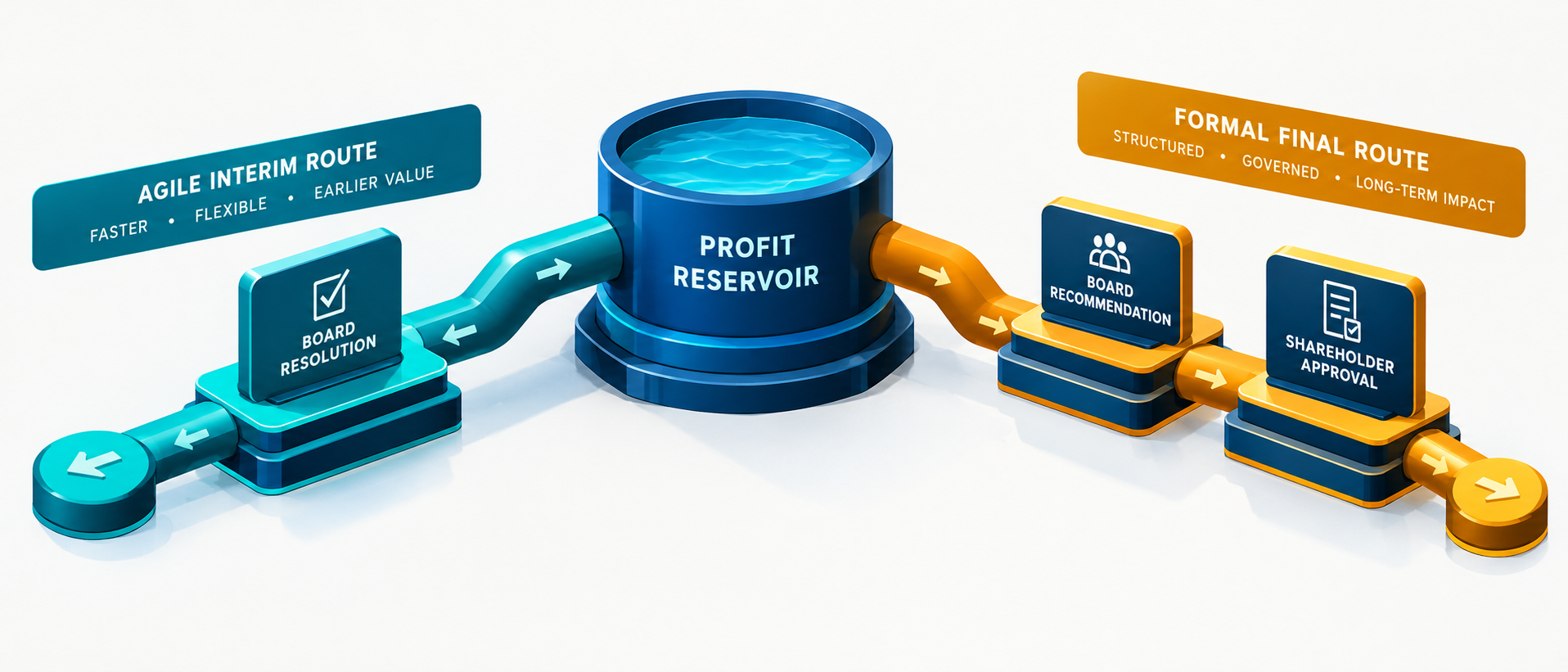
- An interim dividend is commonly approved by directors during a financial year, while a final dividend is commonly recommended by directors and approved by shareholders after year-end.
- The company’s constitution determines who may authorise each dividend and how approval must occur.
- Section 403 of the Companies Act 1967 permits a company to pay dividends only out of profits.
- A large bank balance does not prove that sufficient profits exist for a lawful dividend.
- Singapore one-tier dividends are generally tax-exempt in shareholders’ hands.
- Companies should retain profit calculations, resolutions, vouchers and payment records for every distribution.
Interim and final dividends are distributions of company profits distinguished mainly by their timing and approval process. Section 403 of the Companies Act 1967 states that no dividend is payable to a company’s shareholders except out of profits.[1] An interim dividend is commonly approved by directors before the annual results are finalised, while a final dividend is commonly recommended by directors and approved by shareholders after the financial year. Every Singapore company should check its constitution, calculate the available profits and document the decision before making either payment.
What is the difference between an interim and final dividend?
An interim dividend is generally approved during the financial year based on available financial information, while a final dividend is generally approved after year-end based on completed annual results.
| Point of comparison | Interim dividend | Final dividend |
|---|---|---|
| Typical timing | During the financial year or before the annual accounts are completed | After the financial year, when the annual results are available |
| Common commercial purpose | Distributes profits without waiting until year-end | Distributes the remaining amount considered appropriate for the completed year |
| Common approving body | Board of directors, where the constitution grants that authority | Shareholders following a recommendation from the directors, where the constitution requires member approval |
| Financial information used | Current management accounts and an up-to-date assessment of available profits | Completed or substantially completed annual financial statements |
| Core legal restriction | The dividend must be paid out of profits under section 403 of the Companies Act 1967.[1] | The dividend must be paid out of profits under section 403 of the Companies Act 1967.[1] |
| Usual documentation | Profit assessment, board resolution, dividend voucher and payment record | Profit assessment, directors’ recommendation, shareholder resolution, dividend voucher and payment record |
The labels “interim” and “final” do not override the company’s constitution. A company should follow the authority, voting threshold and procedural requirements in its own constitution.
Who approves an interim and final dividend?
The company’s constitution determines who may approve a dividend, although directors commonly approve interim dividends and shareholders commonly approve final dividends following a directors’ recommendation.
Directors should review the constitution before passing an interim dividend resolution. A customised constitution may impose approval conditions that differ from the standard approach or may protect a particular share class.
A final dividend commonly begins with a board recommendation. Shareholders then consider the recommendation through the procedure permitted by the constitution and the Companies Act 1967, such as a resolution at a general meeting or a written resolution where available.
Shareholders should not increase a proposed final dividend beyond the amount that the directors consider supportable. Directors remain responsible for assessing the company’s profits and the effect of the payment on its financial position.
Must a final dividend be declared at an annual general meeting?
A final dividend does not automatically have to be declared at an annual general meeting because the required procedure depends on the company’s constitution and whether the company holds an AGM.
ACRA states that a private company may be exempt from holding an AGM if it sends its financial statements to members within five months after its financial year end and satisfies the applicable statutory conditions.[4] An AGM-exempt company may therefore use another valid member-approval procedure when its constitution and the Companies Act 1967 permit that procedure.
A listed company or a private company that must hold an AGM should coordinate the proposed final dividend with its financial-reporting and meeting timetable. The company secretary should confirm the correct resolution procedure instead of assuming that year-end timing alone determines approval.
What profit limits apply to interim and final dividends?
Both interim and final dividends may be paid only out of profits.
Section 403 of the Companies Act 1967 states: “No dividend is payable to the share-holders of any company except out of profits.”[1] The statutory rule applies regardless of whether the company calls the payment an interim dividend, final dividend, special dividend or another type of distribution.
A bank balance does not establish the amount available for distribution. Cash may include shareholder loans, bank borrowings, customer deposits, capital contributions or funds needed to settle liabilities.
A finance team should determine available profits from reliable accounting records. The assessment should consider accumulated results, current-period performance, prior dividends, accounting adjustments and losses arising after the latest accounts were prepared.
A company with current-year profits may still have accumulated losses that affect the amount available for distribution. Directors should obtain accounting or legal advice when the profit position is unclear, especially where the company has undergone restructuring, capital reduction, asset revaluation or a material post-balance-sheet event.
Does a company need to pass a solvency test before paying a dividend?
Section 403 imposes a profits-only rule rather than a general statutory solvency test for an ordinary dividend.
Section 403 prohibits dividends that are not paid out of profits.[1] Directors should therefore avoid substituting a cash-flow forecast or a healthy bank balance for a proper profit calculation.
Directors should still assess whether the company can meet its obligations after the payment. A dividend may satisfy the profits-only rule yet create serious commercial and governance problems if the payment leaves insufficient cash for salaries, tax, CPF, suppliers, loans or other liabilities.
Section 403 also provides consequences for a director or chief executive officer who wilfully pays or permits a dividend in contravention of the section, including potential criminal and creditor liability.[1] Directors should record the financial basis for the decision rather than relying on an undocumented view that the company can afford the payment.
How should a Singapore company declare and pay an interim dividend?
A company should verify its constitution, confirm available profits, obtain board approval and retain a complete payment record.
- Review the constitution. Confirm that the board has authority to approve an interim dividend and check any rights attached to different share classes.
- Prepare current financial information. Produce management accounts that are sufficiently current to support the proposed distribution.
- Calculate available profits. Reconcile accumulated profits or losses, current-period results, previous dividends and relevant accounting adjustments.
- Assess cash requirements. Confirm that the company can continue paying tax, payroll, CPF, suppliers, lenders and other liabilities after the distribution.
- Pass a board resolution. Record the dividend amount, rate or amount per share, eligible shareholders, record date, payment date and payment method.
- Prepare dividend vouchers. State the company name, shareholder, shareholding or entitlement, dividend amount and relevant payment details.
- Make the payment. Pay each shareholder according to the resolution and the rights attached to the shares.
- Post the accounting entries. Record the distribution consistently with the applicable financial-reporting framework.
- Retain the evidence. Keep the management accounts, profit calculation, signed resolution, vouchers and bank records together.
How should a Singapore company declare and pay a final dividend?
A company should base a final dividend on its completed annual results, obtain the approvals required by its constitution and document the shareholder entitlement.
- Complete the annual accounts. Establish the profit position for the completed financial year and consider accumulated results from earlier periods.
- Review post-year-end events. Identify losses, liabilities or other developments that affect the directors’ recommendation or the company’s ability to fund the payment.
- Check share rights. Confirm whether ordinary shares, preference shares or other classes carry different dividend entitlements.
- Pass a board recommendation. Record the proposed amount, entitlement basis, record date and intended payment date.
- Obtain member approval where required. Use a general meeting or valid written-resolution process in accordance with the constitution and the Companies Act 1967.
- Prepare dividend vouchers. Create a voucher or statement for each entitled shareholder.
- Pay the dividend. Follow the approved amount, allocation and payment date.
- Record the transaction. Post the dividend payable and payment entries under the applicable accounting framework.
- Retain the corporate records. Store the recommendation, shareholder resolution, profit calculation, vouchers and payment evidence with the company’s statutory and accounting records.
Which documents should support a dividend payment?
A complete dividend file should show the source of the profits, the approving authority, each shareholder’s entitlement and the completed payment.
| Document | Purpose |
|---|---|
| Company constitution | Confirms the approval powers, voting procedure and rights attached to each share class |
| Current management accounts | Supports an interim dividend using recent financial information |
| Annual financial statements | Supports the profit position considered for a final dividend |
| Profit-availability calculation | Reconciles earnings, losses, prior distributions and relevant adjustments |
| Cash-flow assessment | Shows the expected effect of the payment on operating obligations |
| Board resolution | Records the interim approval or final-dividend recommendation |
| Shareholder resolution | Records member approval where the constitution requires it for a final dividend |
| Register of members or share records | Identifies eligible shareholders and their holdings |
| Dividend vouchers | Communicate each shareholder’s entitlement and payment details |
| Bank payment evidence | Confirms that the approved distribution was paid |
| Accounting records | Show the recognition and settlement of the dividend |
The company should use consistent dates and amounts across every document. Conflicting record dates, payment dates or dividend figures can create accounting, audit and shareholder disputes.
How are interim and final dividends recorded in the accounts?
A dividend becomes an accounting liability when it is appropriately authorised and is no longer at the company’s discretion under the applicable reporting framework.
Singapore companies must apply the financial-reporting framework that applies to their circumstances, such as Singapore Financial Reporting Standards (International), Financial Reporting Standards or the Singapore Financial Reporting Standard for Small Entities.[2]
FRS 10 addresses dividends declared after the reporting period. A dividend declared after the reporting period but before the financial statements are authorised for issue is not recognised as a liability at the reporting date because no obligation existed at that date; the required disclosure should instead be considered under the applicable standards.[2]
The accounting date may therefore differ from the financial year to which management informally associates the dividend. The company’s accountant should use the actual authorisation date and the applicable approval mechanics when determining recognition.
How are interim and final dividends taxed in Singapore?
Interim and final dividends paid by a Singapore resident company under the one-tier corporate tax system are generally not taxable in the shareholders’ hands, except for dividends from co-operatives.
IRAS states that the tax paid by a Singapore resident company under the one-tier corporate tax system is final and that dividends paid to shareholders under that system are generally not taxable.[3] The tax treatment does not depend on whether the distribution is labelled interim or final.
Different rules may apply to foreign dividends, partnership receipts, co-operative distributions and shareholders in other jurisdictions. A company with overseas shareholders should avoid representing the Singapore exemption as tax advice for the shareholder’s country of residence.
Can interim and final dividends be different amounts?
Interim and final dividends can be different amounts because each distribution is based on a separate decision, profit assessment and set of commercial circumstances.
A company may pay a modest interim dividend during a profitable period and recommend a larger final dividend after completing the annual accounts. A company may also reduce or omit a final dividend when later losses, liabilities or cash requirements change the financial position.
No fixed ratio must ordinarily exist between interim and final dividends. The company must apply the rights attached to each class of shares consistently and ensure that every payment comes from profits as required by section 403.[1]
What mistakes create risk when paying dividends?
The most serious dividend mistakes involve unsupported profits, incorrect approval, unequal allocation and incomplete records.
Common mistakes include:
- Treating the corporate bank balance as proof of distributable profits.
- Ignoring accumulated losses when reviewing current-year earnings.
- Paying shareholders before the required resolution is passed.
- Using a board resolution for a final dividend when the constitution requires shareholder approval.
- Declaring an amount that exceeds the directors’ supported recommendation.
- Applying the same entitlement to shares carrying different dividend rights.
- Paying selected shareholders informally without a documented basis.
- Omitting dividend vouchers or using dates that conflict with the resolutions.
- Recording a year-end liability before the dividend has been appropriately authorised.
- Distributing cash needed for tax, payroll, CPF or creditors.
A company should correct documentation errors before payment where possible. A company that may have paid an unlawful dividend should obtain legal and accounting advice promptly because section 403 provides for liability where a director or chief executive officer wilfully permits a dividend to be paid contrary to the profits-only rule.[1]
How do interim and final dividends work in a practical example?
A growing private company can use an interim dividend during the year and a final dividend after year-end if each payment has separate financial support and valid approval.
An anonymised Singapore private company has two ordinary shareholders with equal dividend rights. Management accounts prepared during September show profits, but the company expects substantial supplier and tax payments before year-end.
The directors review the constitution, accumulated results, current management accounts and upcoming liabilities. The directors approve a conservative interim dividend, issue equal dividend vouchers and retain the supporting calculation with the board resolution.
The company completes its annual financial statements after the financial year ends. The annual results show that additional profits remain after accounting for the interim distribution and year-end adjustments.
The directors recommend a final dividend based on the completed figures. The shareholders approve the final dividend through the procedure permitted by the constitution, and the company records and pays the amount separately from the earlier interim dividend.
The example shows why the company should not combine both payments into one undocumented withdrawal. Each dividend requires its own profit assessment, authority, entitlement calculation and audit trail.
How does an interim or final dividend compare with a director’s salary?
A dividend rewards share ownership, while salary or a director’s fee compensates work or office-holding.
| Issue | Dividend | Salary or director’s fee |
|---|---|---|
| Basis | Shareholding and the rights attached to the shares | Employment, services or office-holding |
| Profit restriction | A dividend may be paid only out of profits under section 403.[1] | Remuneration is assessed under its contractual, corporate and tax basis |
| Approval | Governed by the constitution and dividend approval process | Governed by the employment arrangement, constitution and applicable approval process |
| Allocation | Usually follows share rights and holdings | Reflects agreed remuneration rather than share ownership |
| Records | Resolutions, profit calculation, vouchers and payment evidence | Contract, payroll or fee approval, payslips and payment evidence |
| Tax treatment | Singapore one-tier dividends are generally not taxable in shareholders’ hands.[3] | Remuneration may be taxable to the recipient and may trigger payroll reporting or CPF obligations |
A shareholder-director should not relabel remuneration as a dividend merely to change the tax or payroll result. The company should document the genuine legal and commercial basis of each payment.
How can E&H Corporate Services support dividend compliance?
E&H Corporate Services can coordinate the corporate secretarial, accounting and tax work required for a properly documented dividend.
Planning an interim or final dividend? E&H Corporate Services can review the company’s constitution, prepare board and shareholder resolutions, reconcile the accounting figures, produce dividend vouchers and coordinate the relevant tax and annual-compliance records. Obtain advice before transferring funds when the company has accumulated losses, multiple share classes or uncertain retained earnings.
Frequently Asked Questions
The following answers address common questions about approval, timing, profits, tax and documentation.
Can a Singapore company pay an interim dividend every month?
Yes, a company can approve interim dividends at more than one point during the year if its constitution permits the approvals and sufficient profits support every payment. Each dividend should have its own current profit assessment and resolution.
Can directors declare a final dividend without shareholders?
The company’s constitution determines the required authority. A final dividend commonly requires a directors’ recommendation followed by shareholder approval, so directors should check the constitution before treating board approval as sufficient.
Can shareholders increase the final dividend recommended by directors?
Shareholders should not increase a final dividend beyond the amount supported and recommended by the directors. The directors must assess the profits and financial effect of the proposed distribution.
Can a company pay a dividend when it has cash but accumulated losses?
A company cannot rely on cash alone because section 403 permits dividends only out of profits.[1] The company should obtain professional advice where accumulated losses make the available-profit calculation uncertain.
Are interim dividends taxable in Singapore?
Interim dividends paid by a Singapore resident company under the one-tier corporate tax system are generally not taxable in shareholders’ hands, except for dividends from co-operatives.[3] A shareholder who is tax-resident elsewhere should check the rules of the relevant jurisdiction.
Does a company file every dividend with ACRA?
A dividend primarily requires proper internal corporate and accounting records rather than an assumption that approval is completed through an ACRA transaction filing. The company should still reflect the financial effects in the applicable accounts and annual-compliance records.
What is the most important document for an interim dividend?
A supported board resolution is central, but the resolution should be retained with current management accounts and the available-profit calculation. A resolution without reliable financial evidence does not establish that the dividend came from profits.
Can a company pay a final dividend before its AGM?
A company may use the approval process permitted by its constitution and the Companies Act 1967. An AGM-exempt private company should confirm whether a valid written resolution or another member-approval procedure is available before payment.
Related reading
- Dividends in Singapore: How Do Companies Pay Them?
- Shareholders & Share Capital
- How are dividends distributed to foreign shareholders, and is there a withholding tax?
Sources & References
- Companies Act 1967, Section 403: Dividends Payable from Profits Only — Singapore Statutes Online
- Singapore Financial Reporting Standards — Singapore Accounting Standards Council
- Tax Treatment of Dividends — Inland Revenue Authority of Singapore
- Annual Returns and AGM Requirements — Accounting and Corporate Regulatory Authority